In a world of short attention spans and endless scrolls, you have just seconds to turn a click into a customer. And that’s exactly what a landing page is designed to do.
But here’s the problem: Most landing pages don’t convert.
They might look good. They might even drive traffic. But if they’re not compelling, focused and strategically built, they won’t generate leads.
So, what makes a landing page actually work? And more importantly, how do you build one that turns visitors into enquiries, bookings or purchases?
Let’s take a look.
What is a landing page – and why do they matter?
Unlike a home page or blog post, a landing page has one clear purpose:
To guide visitors towards a single action – whether that’s filling in a form, booking a call, downloading a guide or making a purchase.
This specific focus is why landing pages tend to outperform generic website pages when it comes to conversion. They remove distractions, create urgency and speak directly to the visitor’s needs.
The best landing pages are:
- Laser-focused on one goal
- Written for a single audience
- Structured to eliminate friction
- Designed with clear visual hierarchy
- Optimised for mobile and fast loading
In short, they’re built to convert. But that doesn’t happen by accident.
What makes a landing page convert?
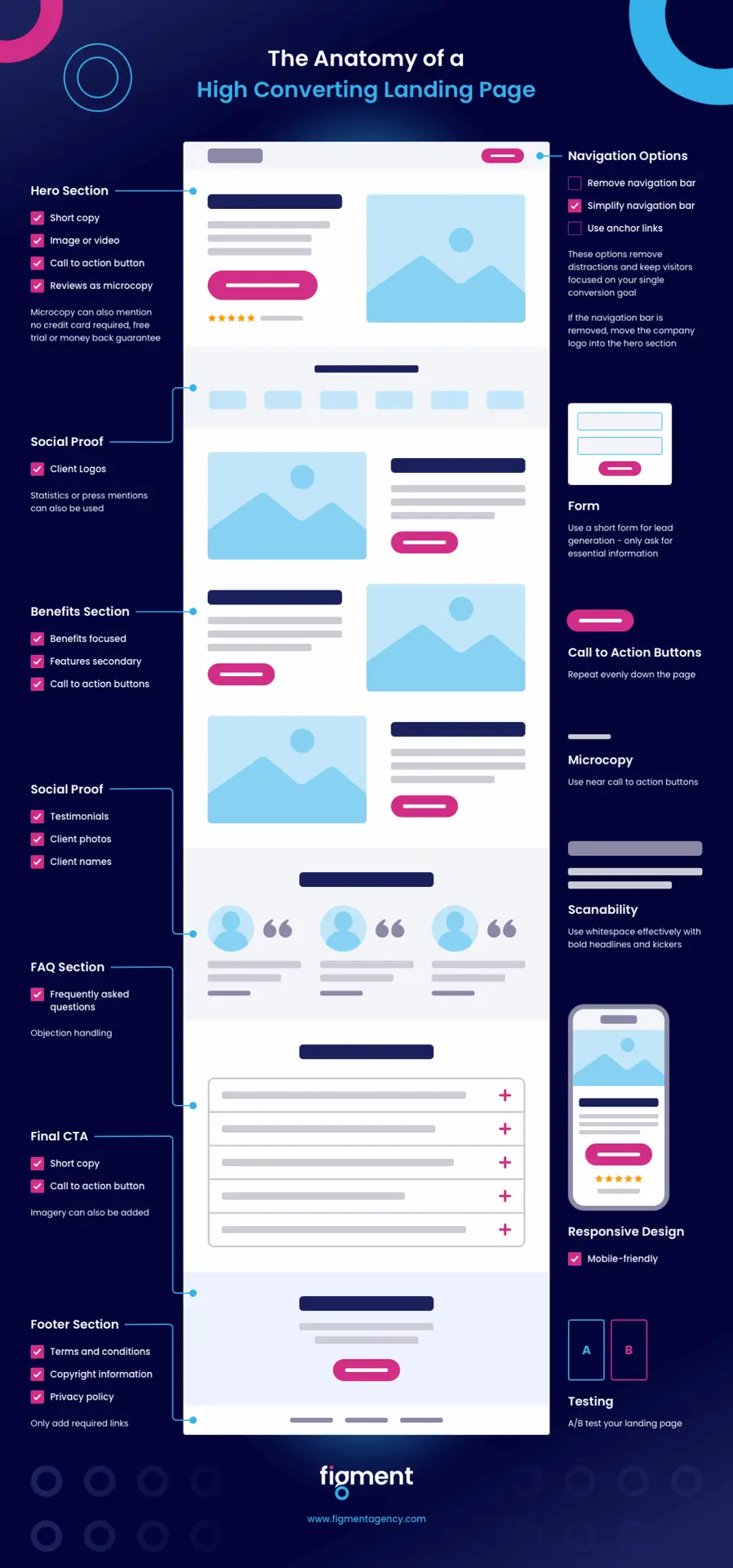
Great landing pages combine psychology, design, and data. Here’s what you need to include:
1. A strong benefit and / or pain-point-driven headline
The headline is your hook. It’s the first thing visitors see – and often the last if it doesn’t grab them.
Your headline should:
- Focus on the outcome (what’s in it for visitors in terms of real benefits or solving pain points?)
- Be clear, not clever
- Align with the ad or link that brought them there
For example:
“Grow Your Business with Expert PPC Campaigns”
is far more effective than
“Results-Oriented Digital Marketing Solutions”
2. A persuasive subheading
The subheading supports the headline and provides a little more context. Think of it as your chance to say:
“You’re in the right place – here’s why.”
It should highlight the pain point or need, then immediately offer a solution.
3. Compelling copy that answers real problems
You’re not writing an essay – you’re having a conversation.
Good landing page copy:
- Uses short, scannable sentences
- Speaks in the voice of the audience
- Focuses on benefits, not features
- Addresses objections or doubts upfront
And most importantly, it should make the visitor think:
“This is exactly what I’ve been looking for.”
4. Clear, action-oriented CTAs
The call-to-action (CTA) is your chance to influence the visitor’s next step. It needs to stand out visually and be emotionally compelling. The best CTAs require the least possible input and offer the best possible outcome for your audience.
Instead of a generic “Submit” button, try:
- “Get My Free Quote”
- “Book My Discovery Call”
- “Claim Your Free Trial”
Top tip: Repeat your CTA throughout the page, especially after key sections. Consider variations to communicate with visitors at different stages of their buying decision, and to appeal to a wider catchment.
5. Social proof and trust signals
People buy from brands they trust. Add credibility with:
- Customer testimonials
- Case studies or client logos
- Star ratings
- Media mentions or certifications
If you’re targeting particularly competitive markets, strong social proof can be the deciding factor that sets your offer apart.
6. Clean, focused design
Design isn’t just about aesthetics – it’s about directing attention.
Use design to:
- Place the CTA early on the page
- Use white space to improve readability
- Highlight key benefits with icons or bullets
- Make the page mobile-friendly
Remember: less clutter = more conversions.
Common landing page mistakes to avoid
Even the best offers can underperform if the page design lets them down. Here are some pitfalls to steer clear of:
- Too many CTAs (confusing the user)
- Long contact forms with unnecessary mandatory fields
- Unclear messaging
- Slow page loading speed (especially on mobile)
- No follow-up plan (e.g. thank-you page, email autoresponder)
Should you use a template, or build your landing page from scratch?
Many businesses use landing page builders like Unbounce, Instapage, or Webflow. They are useful tools when used correctly.
Templates can work well if:
- You customise the copy and design
- The layout fits your conversion goal
- You A/B test elements like headlines and CTAs
If you’re running ad campaigns, especially Google Ads, a well-optimised landing page can dramatically improve your ROI. In fact, aligning your landing page with your ad group is a core strategy we use as a performance-driven PPC agency in London.
Tracking, testing and tuning: the real secret to higher conversions
A landing page should never be treated as a one-and-done project. The top performers are constantly tested and tweaked.
Metrics to watch:
- Conversion rate (form submissions ÷ total visitors)
- Bounce rate (are people leaving too quickly?)
- Scroll depth (are people seeing the CTA?)
- Page load speed
Start by testing:
- Headlines
- CTA button text or colour
- Layout changes (e.g. image position, testimonials placement)
- Different offers (e.g. free trial vs. free audit)
The key: Only change one element at a time so you know what’s making a difference.
Do landing pages still matter in 2025?
With AI-generated content and dynamic search experiences on the rise, you might wonder if landing pages still have a place.
Absolutely. But they must evolve.
Today’s top-performing landing pages are:
- Rich with intent-led content
- Tailored to answer AI-powered search queries
- Built to showcase E-E-A-T (Expertise, Experience, Authoritativeness, Trust)
- Designed for zero-friction conversion paths
In an age of AI Overviews and predictive search, landing pages can serve as high-quality sources for both human users and machine-generated results – but only if they’re built with clarity, authority and genuine relevance.
Final thoughts: ready to optimise your landing pages?
If your landing pages aren’t converting, your business could be missing out on hundreds of potential leads every month.
It’s not just about having a good-looking page. It’s about:
- Saying the right things in the right order
- Speaking directly to your audience’s problems
- Guiding your audience to take action – without resistance
At Figment, we blend data-driven design with persuasive copy and strategic testing to create landing pages that actually convert. If you want results, you should work with a London SEO agency that understands both search and conversion optimisation. Whether you’re building pages for PPC, email campaigns, or AI search traffic, we’re here to help.