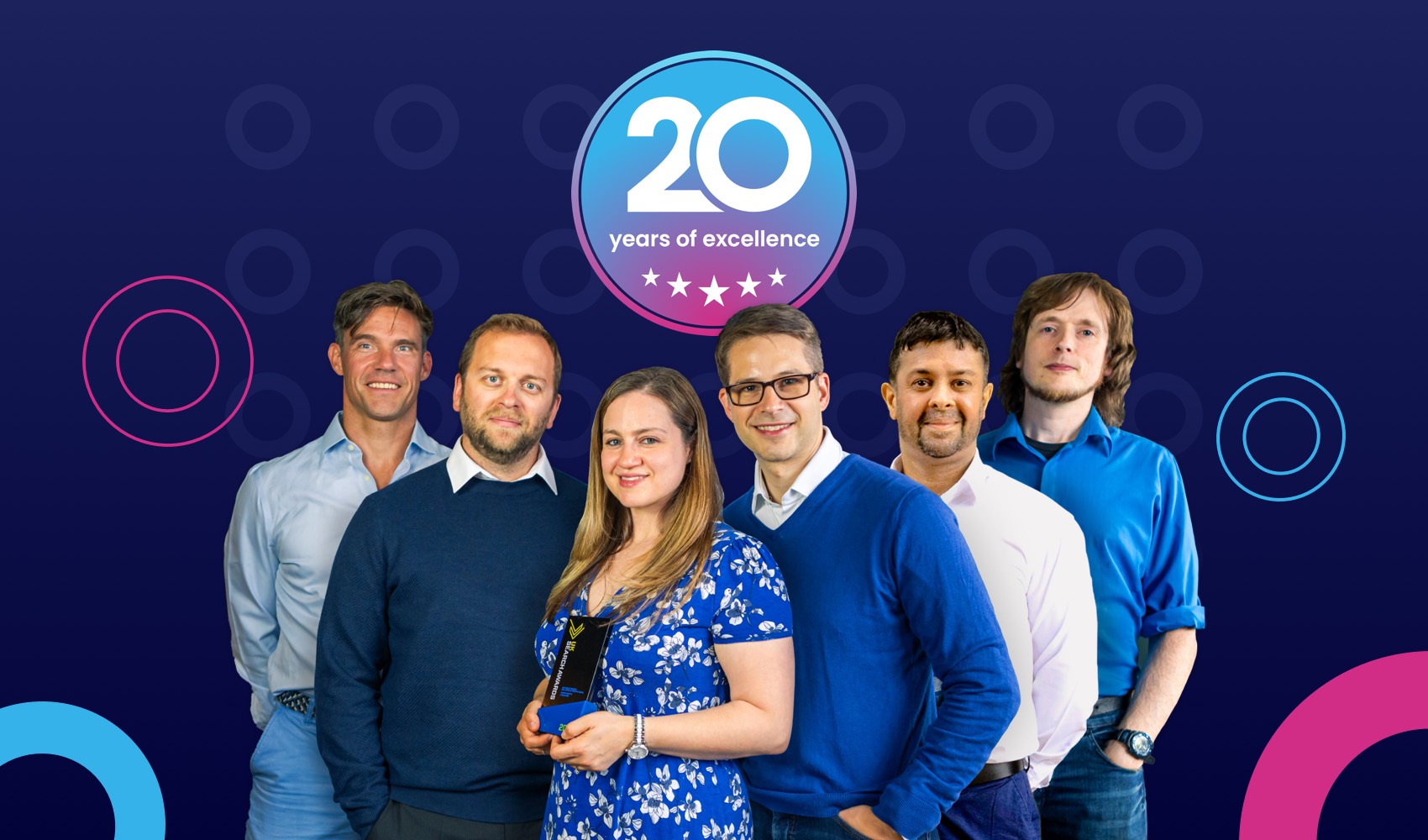
On Valentine’s Day, 14 February 2006, we launched Figment
Back then, Facebook was barely a year old. Marketing meant desktop-first websites and email footers with Comic Sans. SEO was something whispered about in forums. And ChatGPT? Not even a dream.
Fast forward 20 years and here we are. Still standing strong, still evolving, and still helping brands be the answer.
But this isn’t a nostalgia piece. It’s a reflection on what’s changed, what hasn’t, and why visibility today demands more than a marketing checklist.
So much of Figment’s journey has been about adapting without selling out.
Emma joined the business the same week we got married. We grew Figment while raising a family. Navigated Covid with a newborn in the house. Held boundaries when it mattered. Rebuilt when needed. But one constant? We kept choosing sustainable growth over short-term workarounds.
We’ve been lucky to work with clients who value trust, clarity, and long-term thinking. Because that’s what we’ve built the business on.
And 20 years in, the view is clearer than ever. Here’s the story.
The digital evolution – from web design to AI-powered search
In 2006, a website was your marketing strategy. If you had one, you were ahead of the game. If it was mobile-friendly — well, you were basically NASA.
I was in my early 20s, knocking on doors around Penny Lane in my native Liverpool, asking local businesses if they needed a website. Most didn’t have one. Some weren’t quite sure why they would.
In the evenings, I worked from the snooker room above my dad’s shop — dial-up internet, Dreamweaver, FTP uploads that gave you enough time to make a cuppa while the files loaded. No business plan, no grand vision. Just a gut feeling that this digital thing mattered.
It was only when my mentor, Kian Kormi, sat me down and explained the benefits of becoming a limited company that I realised: I’m actually doing this.
Fast forward ten years, and Figment had grown into something real — and then Emma joined. That same week, we got married. So things got pretty intertwined, pretty quickly.

Figment wasn’t some shiny new start-up by that point. We had long-standing clients, established systems, and a lot of lessons behind us. But the industry was shifting fast.
Websites were no longer the differentiator. SEO was becoming more than just meta tags and backlinks. Visibility mattered more than visuals. Strategy mattered more than tactics. We had to evolve.
And we did. We let go of old labels — we’re not just a web agency, or just SEO specialists.
Because digital has changed. Search behaviour has changed.
You can show up in an AI answer box now without anyone ever visiting your site. A user might talk to their phone instead of typing. You might rank because someone cited your brand in a podcast transcript.
We’ve adapted — not by chasing every shiny thing, but by staying intentional rather than being knee-jerk reactive. Learning where things are going. Making space for what matters. Knowing when to double down, and when to stop.
Because the platforms keep changing. But the goal hasn’t: help great businesses be seen, be trusted, and keep growing — whatever the tech throws at us next.
Trust has always been the real SEO
We’ve seen a lot of fads over the years. Keyword stuffing. Link farms. Exact-match domains. You name it, someone’s tried to game the system with it.
But the clients who’ve stuck with us? They weren’t chasing hacks. They were building something solid. And they knew that real visibility — the kind that lasts — is built on trust.
That’s never changed.
In the early days, it meant creating websites that actually made sense to real people. Then it meant writing content that answered real questions.
Now it means being credible enough to be cited by an AI. But underneath all of it, the principle’s the same: build trust, and visibility follows.
Emma’s strategic input has brought huge clarity to this over the years. She’s got a way of helping clients step back and see the bigger picture. Not just “what will rank?”, but “what will resonate?”, “what’s worth saying?”, and “what do you want to be known for?”
These days, Google’s not the only one paying attention. Language models are too. And both care about the same things: Expertise, Experience, Authority, and Trust.
That’s why we’ve stayed focused on human-led SEO. It’s not just about ticking EEAT boxes. It’s about helping the right people find you — and believe in you — because you’ve shown up with clarity, value and purpose.
You can’t fake that. Not for long, anyway.
And that’s the thing about trust. It compounds. And in our world, it still outperforms any short-term SEO trick going.
Leading a business that lasts
If you’d asked me in the early days what success looked like, I’d have said: freedom. Flexibility. Doing work I enjoyed.
What I didn’t realise at the time was that freedom isn’t just about being your own boss. It’s about building something that can function without you constantly firefighting. That took a while to learn.
There’s a lot of noise in our industry about hustle. Working all hours. Scaling fast. Pivoting every six months.
That’s never really been us. We’ve grown slowly and intentionally. Not because we lacked ambition, but because we knew the kind of business we wanted to build.
A sustainable one. A human one. One that could support a team, and adapt when life threw curveballs. Which it absolutely did.
Emma and I welcomed our son into the world during just a few months before the pandemic hit. Running a business as new parents through lockdown was a lesson in boundaries, patience, and leaning on your systems. And your people.
Those years really shaped how we lead now. We put a huge focus on process — not for the sake of bureaucracy, but because systems create breathing space. They mean client quality doesn’t suffer when someone’s off sick. They mean nobody’s burning out trying to do it all.
We’re still hands-on, still close to the work. But we’re not trying to be heroes. And we’ve learned that the real markers of success aren’t awards or headlines. They’re things like having a team that buys into your values, clients who stay loyal year after year, and a business that doesn’t fall apart when life gets messy.
And when your business partner is also your partner-partner? Let’s just say you learn a lot about communication. And when you’re parents? You get very good at tag team tactics.
The AI era: What hasn’t changed
It’s impossible to reflect on 20 years in digital without talking about AI. It’s everywhere. And it’s not slowing down.
But here’s the thing: AI hasn’t replaced the foundations of good marketing. It’s just changed the tools.
When ChatGPT landed, there was a lot of noise. Agencies scrambled to productise it. LinkedIn lit up with self-declared AI experts.
We watched, we listened — and we kept our heads.
At Figment, we didn’t jump into LLM optimisation because it was trendy. We did it because it aligned with what we’ve always done: helping expert-led businesses get seen and trusted online.
AI isn’t a magic wand. It doesn’t create strategy. It doesn’t replace lived experience.
What it does do is speed up what’s already there. But what does this mean for the gaps in your content, your credibility, your authority? AI exposes them faster.
We’ve seen first-hand how the content saturation problem has got worse. Pages stuffed with generic AI copy. Advice with no source. Thought leadership with no actual thought.
That’s not visibility. That’s digital clutter.
In this new landscape, trust is the differentiator. The brands getting picked up by AI — and by people — are the ones offering real substance. Real expertise. Real clarity.
And if that sounds familiar, it’s because it’s always been the case. The technology is new. The principle isn’t.
Who we serve – and why
If there’s one thing 20 years has taught us, it’s this: the best work happens when there’s a values match.
Not every business wants to build trust over time. Some want quick wins, vanity metrics, or whatever tactic is trending that month.
That’s not us.
Figment works best with expert-led businesses. People who’ve built something real and want to grow it sustainably. Financial planners. Healthcare providers. Property specialists. People who take their reputation seriously because it’s built on knowledge, and trust.
And that matters more than ever now. Visibility in 2026 isn’t about being everywhere. It’s about being the answer.
When someone searches a complex question — whether it’s “how do I protect my family wealth?” or “which fertility clinic has the best outcomes?” — the content that gets surfaced is the content that shows clarity, authority, and intent to help.
That’s what we build.
We’ve spent two decades refining our strategy. Not chasing algorithms, but adapting to serve the businesses we believe in. Businesses that know their value but need help being seen for it.
That’s the sweet spot. That’s our why.

Looking ahead: built for what’s next
Twenty years in digital is a huge achievement. But we’re not interested in milestones for the sake of them.
To us, 20 years means we’re still relevant — still resilient — and still trusted by the kind of clients we set out to serve.
We’ve never chased the loudest trends. We’ve never tried to be the flashiest agency in the room. What we’ve done — consistently — is help expert-led businesses become visible in ways that last.
That mission hasn’t changed. But the landscape has. AI-powered search, LLM-driven discovery, answer-first visibility. The pace of change is dizzying. And yet, the fundamentals still apply: clear communication, credibility, consistency.
We’re not here to chase the next marketing trend. We’re here to make sense of it — and help our clients do the same.
We’re excited about what comes next, and if you are too, we’d love to share your journey.

I’ve not changed much. Well, maybe a bit ;)