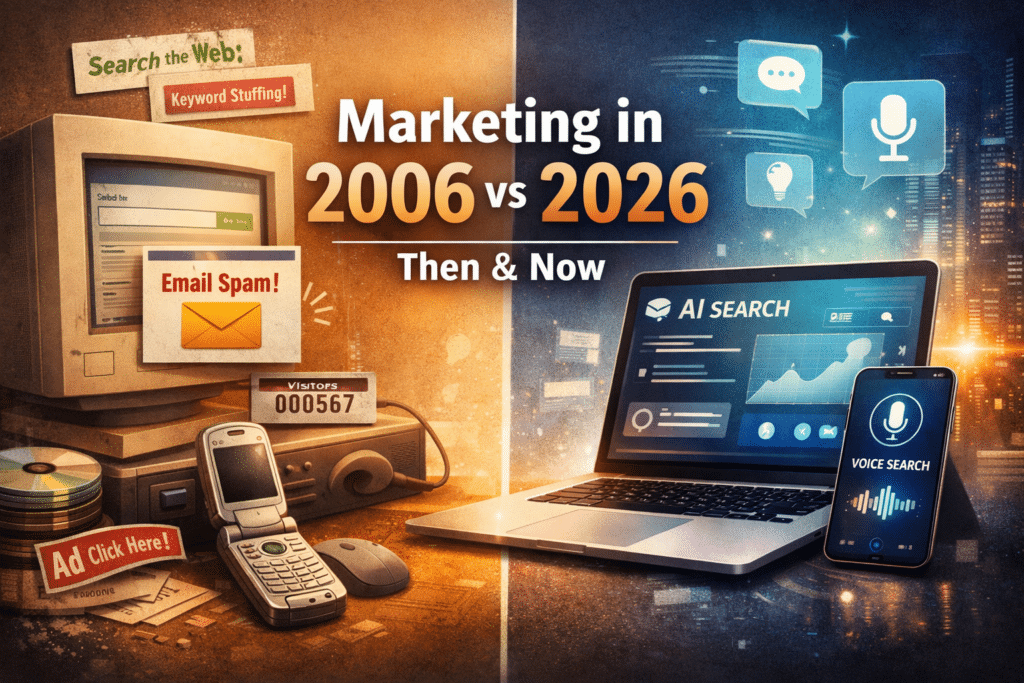
2006 Called… It wants its marketing back ;)
2006. The year Twitter launched, Facebook still needed a university email address, and most business websites had a “Click Here to Enter” splash page. Mobile phones flipped. Fonts were… expressive. And if your business had a website at all, you were ahead of the game.
Two decades later, the landscape is unrecognisable. But every now and then, a milestone (like Figment turning 20 🎉) gives you a reason to pause and reflect on how far we’ve come, and what’s actually stayed the same.
So here’s a light-hearted look at digital marketing, then and now. Spoiler: some tactics have aged about as well as Internet Explorer. Others? They’re still at the heart of what works. And those are the ones we’re most interested in.
How we used to search
In 2006, your choice of search engines said a lot about you.
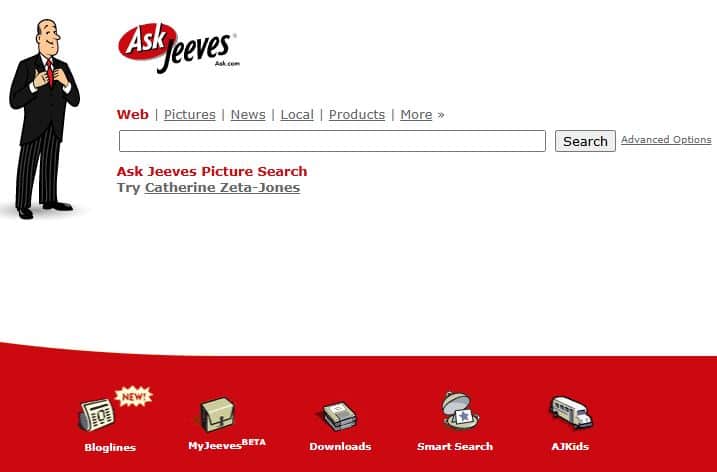
You might’ve been loyal to Yahoo, curious about Ask Jeeves, or starting to warm to Google (which still had that “start-up” vibe – and wasn’t anywhere near reaching “verb” status).
And while the interfaces were charmingly basic, so was the search behaviour.
No autocomplete. No voice commands. No AI summaries delivering neat answers in boxes. If you wanted to find something, you had to think like a search engine — and type exactly what it wanted to see.
Fast forward to 2026, and search technology has evolved beyond recognition. AI-powered search engines don’t just fetch results — they interpret intent, summarise sources, and answer follow-up questions before you even ask them.
AI-enhanced search means users expect clarity, credibility, and context — instantly.
In 2006, it was enough to rank for a phrase like “best accountant London”. Now, someone might ask their voice assistant “Who’s a good accountant for tech start-ups in South West London with five-star reviews?” And they expect an actual answer — not just a list of links.
Two decades on, the big search engine shift isn’t just visual. It’s how search has gone from literal to layered. Understanding this evolution is key to modern marketing.
Because if your content doesn’t answer real questions using real-life, human-based scenarios, it’s invisible.
How we used to market
Back in 2006, a website was basically a brochure on a screen. If it had your phone number, a few paragraphs about what you did, and some contact details, job done.
Digital marketing didn’t mean strategy — it meant having something online. Maybe a banner ad or two. Maybe an email newsletter, usually in Comic Sans, with a dodgy bit of Clip Art thrown in.
And if you were really on it, you had a “links” page to swap backlinks with other businesses.
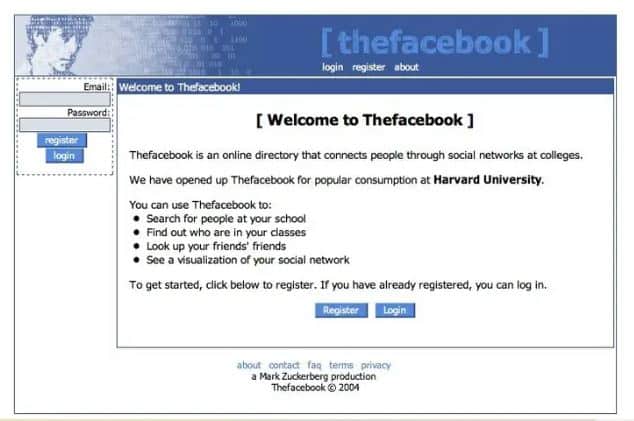
There was no talk of content calendars or funnels. And social media? You might’ve had a Facebook page by mistake — set up as a personal profile, with no idea what to do with it. But back in the day, ‘Thefacebook’ was simply a student tool, and YouTube? A far cry from the money-making platform it’s become today.

SEO was simple too: keywords in the page title, a few backlinks, and maybe a white-text-on-white-background trick if you were feeling sneaky. The idea of trust or experience didn’t really enter the picture. It was all about getting seen, not being chosen.
Things look very different now, but those early days taught us a lot. Mostly that just being online isn’t enough. Marketing tactics in 2006 were about presence. In 2026, it’s about purpose.
2006 to 2026 – what’s changed, and what hasn’t?
There’s no denying it — digital marketing in 2026 is more complex than ever.
You’ve got AI search, algorithm shifts, short-form video, long-form content, voice, visuals, and everything in between.
The channels have multiplied. The rules keep changing.
And expectations? Higher than ever.
But strip away the noise, and the core challenge hasn’t budged:
Be visible. Be credible. Be useful.
The tools might be smarter. The strategies might be slicker. But the businesses that stand out today are still the ones that show up consistently, with something worth saying, and a reason to be trusted.
Chasing every new trend doesn’t work. It never really did. The game-changer is showing up with purpose. Understanding your audience. Delivering real value.
And maybe most importantly? Knowing when not to jump on a trend, because shouting louder isn’t the same as showing up smarter.
20 years later – what we know now
Two decades after we launched, on Valentine’s Day 2006, we’ve learnt a lot of lessons. Not just about how the digital world has changed, but about what actually works.
A smart strategy will always beat the fleeting trend. Not because we’re anti-innovation — far from it — but because chasing every new tool or platform rarely delivers long-term value. It’s easy to get caught up in trends. Much harder to stay focused on what matters.
Visibility today isn’t just about your website.
It’s about the ecosystem around it: your search presence, your content footprint, your reputation. Everything connects.
And in 2026? Relationships still matter. The ones you build with your audience. The ones you build with the platforms. The way your content shows up in AI answers, search results, and social feeds is shaped by the consistency and clarity you’ve already established.
Because shouting louder isn’t the same as showing up smarter.
In the end, it’s the trusted, consistent voices that stand the test of time.
Looking back? Really, it’s about moving forward.
It’s been fun looking back over the past 20 years. And yes, we’re still recovering from the memory of Clip Art banners and Comic Sans emails.
But underneath the nostalgia, there’s a clear reminder: good marketing never stands still. It evolves, adapts, and keeps its eye on what really matters.
At Figment, we’ve grown alongside the industry. We’ve shifted with the times, stayed grounded in strategy, and helped our clients do the same.
We’re excited about the future. And if you’re ready to make the next move with clarity, trust and future-ready thinking, we’re ready to support you – let’s talk.