The myth of the instant buyer
Most businesses still imagine marketing working like this.
Someone searches, finds your website, and becomes a customer.
It’s a simple model. It’s also rarely how things actually happen.
The reality is, especially in sectors with longer buying cycles or higher-value services, people don’t make decisions after a single interaction. They research, revisit, compare, and validate before they take action.
The problem isn’t that businesses aren’t doing marketing.
It’s that they’re not achieving enough marketing visibility across enough moments in the buying journey to build trust.
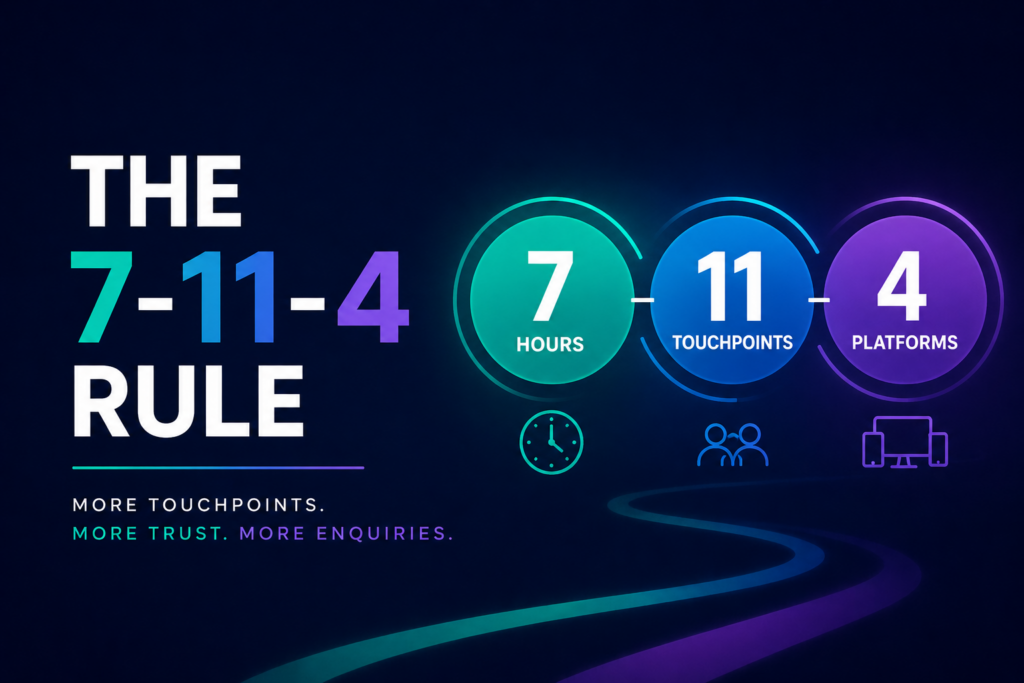
This is where Google’s 7-11-4 rule becomes useful.
It suggests that before making a decision, buyers typically need around:
- 7 hours of interaction with a brand
- 11 different touchpoints
- Across at least 4 platforms
In other words, trust isn’t built in a single visit.
It’s built over time, through repeated exposure.
And in today’s environment — where buyers move between search engines, AI platforms, content and social channels — that journey is becoming more complex, not less.
Understanding buying journey marketing in this way changes how you think about strategy.
It shifts the focus from isolated tactics to consistent presence.
Because if your brand only shows up once or twice in that journey, it’s unlikely to be chosen — regardless of how strong your service is.
What the 7-11-4 rule actually means
The 7-11-4 rule isn’t a rigid formula.
It’s not suggesting that every buyer consciously tracks how many times they’ve seen your brand, or that there’s a precise number of interactions required before someone takes action.
What it does reflect is how modern buying behaviour actually works.
People don’t move in straight lines. They explore, compare, revisit, and build confidence over time.
A typical journey might include:
- Reading a blog that answers an initial question
- Seeing a LinkedIn post that reinforces a point
- Visiting your website to learn more
- Watching a video or reading a guide
- Coming across a case study
- Hearing your brand mentioned elsewhere
- Searching again later when the need becomes more urgent
Each of these moments adds something.
Individually, they may seem small. Collectively, they build familiarity, credibility, and trust.
This is what long buying cycle marketing really looks like in practice.
And it’s where many businesses underestimate what’s required.
Because if your brand only appears once or twice in that journey, you’re unlikely to be chosen — regardless of how strong your service is.
The brands that win aren’t always the ones with the best offer.
They’re the ones that are consistently present across the buying journey, building content marketing trust and reinforcing their position at every stage.
Why this matters in 2026
If the 7-11-4 rule has been shaping buying behaviour for years, it’s even more relevant now.
What’s changed isn’t the need for trust.
It’s the speed and complexity of how that trust is built.
Today’s buyers don’t rely on a single source. They move between platforms, contexts, and formats as they research and validate their decisions.
They might:
- See your insight on LinkedIn
- Search for your brand on Google
- Ask a question in an AI tool like ChatGPT or Google Gemini
- Read a blog or case study
- Come back weeks later when they’re ready to act
That journey isn’t unusual. It’s becoming the norm.
And this is where things start to shift.
AI doesn’t replace this journey — it accelerates it.
Buyers can now validate, compare and shortlist brands faster than ever. They can ask more specific questions, explore different angles, and sense-check what they’re reading in seconds.
Which means the bar for brand trust marketing and digital trust signals is higher.
You’re not just being compared against competitors.
You’re being tested across multiple sources, platforms, and perspectives — often before you even know a potential customer exists.
This is why marketing visibility now extends beyond traditional search.
It includes:
- AI-generated answers and citations
- Expert-led content that can be referenced
- Consistent messaging across platforms
- Signals of credibility that hold up under scrutiny
Because when buyers can access more information, more quickly, they don’t skip the trust-building process.
They compress it.
And if your brand isn’t visible across that compressed journey, it simply doesn’t make the shortlist.
The 7-11-4 rule and the “Be the Answer” mindset
At Figment, we often talk about helping brands be the answer.
It’s a simple idea, but it’s often misunderstood.
“Be the Answer” isn’t a slogan.
It’s a practical way of ensuring your brand shows up consistently across the full 7-11-4 journey.
If buyers need multiple interactions, across multiple platforms, before they trust you, then your visibility can’t rely on a single moment.
It has to be built deliberately.
That means showing up wherever your audience is looking for clarity, whether that’s:
- Search results
- AI-generated answers
- Industry commentary
- Expert-led content
- Case studies and real-world examples
Each of these interactions becomes part of your marketing touchpoints strategy.
Individually, they might not drive an enquiry.
Collectively, they build familiarity and trust.
This is where many businesses fall short.
They focus on isolated tactics — a blog here, a campaign there — without connecting them into a wider strategy. As a result, they appear sporadically rather than consistently.
And that breaks the trust-building process.
A “Be the Answer” approach works differently.
It focuses on creating a connected presence across the entire buying journey, so that wherever a potential customer looks — whether that’s Google, AI platforms, or industry content — your brand is already there.
Not once. But repeatedly.
Over time, those interactions compound.
And when the buying moment finally arrives, your brand doesn’t need to introduce itself.
It’s already familiar. Already credible. Already trusted.
That’s what turns visibility into enquiries.
And it’s why marketing visibility isn’t about being seen once.
It’s about being recognised over time.
Visibility isn’t just SEO anymore
For a long time, visibility was closely tied to search rankings.
If you appeared near the top of Google for the right keywords, you were in a strong position to generate enquiries. That model still has value, but it’s no longer enough on its own.
Ranking once is no longer enough to win the enquiry.
The 7-11-4 rule makes that clear.
If buyers need multiple interactions across multiple platforms before they trust a brand, then visibility can’t be limited to a single search result or moment in time.
It has to extend across the wider journey.
This is where marketing visibility becomes more than just SEO.
It becomes an ecosystem of digital trust signals that reinforce your credibility wherever your audience encounters you.
That might include:
- Expert-led content that answers real questions
- Thought leadership that demonstrates experience
- Case studies that provide proof of expertise and results
- Social content that keeps your brand visible
- PR or industry mentions that add external validation
- Consistent messaging across platforms
Individually, none of these guarantee an enquiry.
But together, they form a brand trust marketing system that supports the full buying journey.
This is also where the shift towards AI and multi-platform discovery becomes important.
Your content isn’t just competing for rankings anymore.
It’s contributing to a broader picture of credibility that can be surfaced, referenced, and validated across different environments.
Which means the goal isn’t simply to rank.
It’s to be recognised.
Because when buyers encounter your brand multiple times, in different contexts, with consistent and useful information, the decision becomes easier.
And that’s ultimately what drives enquiries.
Why most businesses struggle with this
If the 7-11-4 rule reflects how buying decisions actually happen, it also explains why so much marketing underperforms.
Not because it’s poor quality.
But because it isn’t seen often enough, in enough places, to build trust.
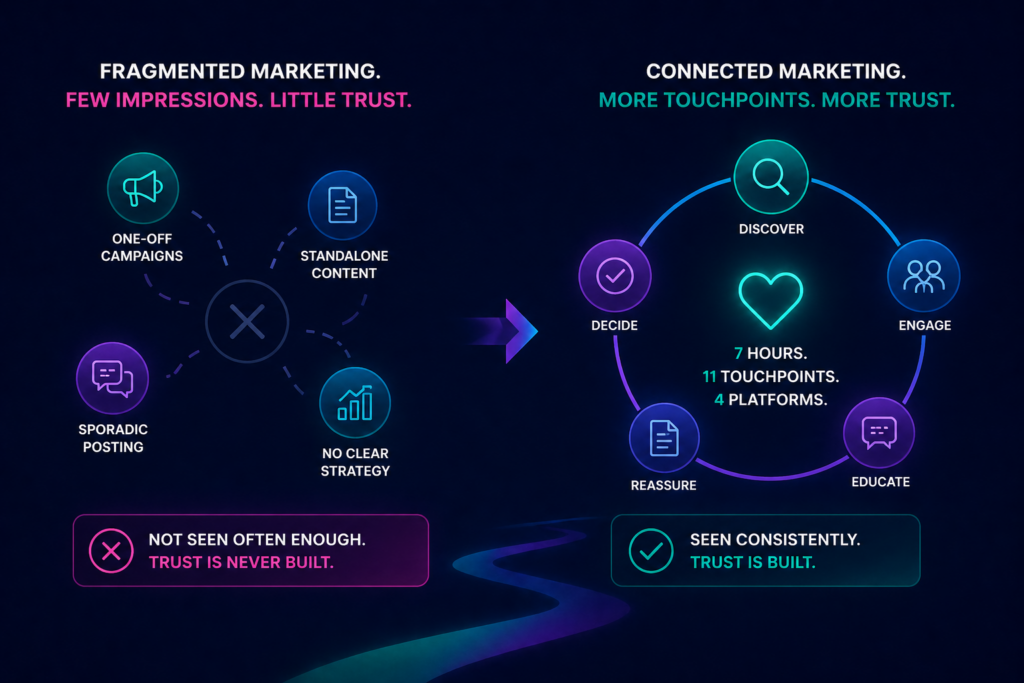
Many businesses still approach marketing in a fragmented way. They focus on individual tactics rather than the wider journey.
That might look like:
- Short-term campaigns designed to generate quick leads
- One-off pieces of content without a clear follow-on
- Sporadic posting across channels
- Activity that isn’t connected into a wider strategy
On the surface, it can feel like progress.
But underneath, it breaks the trust-building process.
Because without consistent visibility across multiple touchpoints, buyers never accumulate those 7 hours of interaction. They encounter your brand once, maybe twice, and then move on.
Which is why many businesses feel like their marketing “isn’t working” — when in reality, it’s just not being seen often enough.
That’s an important distinction.
Because the solution isn’t necessarily to do more.
It’s to be more consistent, more connected, and more visible across the places your audience is already looking.
The role of authority and trust
In expert-led industries, the 7-11-4 rule carries even more weight.
When decisions involve higher costs, greater risk, or specialist knowledge, buyers don’t act quickly. They take time to build confidence in who they’re choosing.
Which means trust isn’t built in a single visit. It’s built over repeated exposure.
Across multiple interactions, buyers are looking for signals that a brand knows what it’s talking about and can be relied on.
This is where concepts like E-E-A-T (Experience, Expertise, Authoritativeness and Trust) become important.
In practical terms, that means:
- Demonstrating real experience, not just surface-level knowledge
- Providing clear, helpful answers to complex questions
- Showing proof through case studies and examples
- Maintaining consistency in messaging and positioning
These are the digital trust signals that build confidence over time.
And in sectors like finance, healthcare, property, or consulting, they’re often the deciding factor.
Because when buyers are making significant decisions, they don’t choose the brand they saw once.
They choose the one they’ve come to trust.
The real lesson behind the 7-11-4 rule
The takeaway from the 7-11-4 rule isn’t that marketing needs more content.
It’s that marketing needs to be more connected.
The goal isn’t to produce more. It’s to create a joined-up visibility strategy that ensures your brand shows up repeatedly across the buying journey.
That means thinking beyond individual tactics and focusing on how each interaction supports the next.
Not noise.
Not volume.
But consistent, useful presence in the places your audience already spends time.
In practical terms, this might look like:
- A prospect first finding you through search
- Seeing your insight on LinkedIn
- Reading a blog that answers their question
- Checking a case study for reassurance
- Asking an AI platform about your expertise
- Returning later when they’re ready to enquire
None of these moments work in isolation.
But together, they create the familiarity and trust that drives action.
This is what effective marketing touchpoints strategy and buying journey marketing look like in practice.
It’s not about being everywhere.
It’s about being present in the right places, often enough, and with enough consistency to build confidence over time.
Because by the time someone is ready to make a decision, they’re not choosing the brand they’ve just discovered.
They’re choosing the one they already recognise.
Your next marketing move: build visibility, not noise
When you want to attract more leads and strengthen your sales pipeline, it’s easy to assume the answer is to do more marketing.
More content. More campaigns. More activity.
But the 7-11-4 rule shows that’s not the real issue.
Most businesses aren’t struggling because they’re not doing enough marketing.
They’re struggling because they’re not visible often enough, in enough places, to build trust.
This isn’t about choosing between channels or tactics.
It’s about creating a connected presence across the buying journey, so your brand shows up consistently over time.
The businesses that get ahead won’t be the ones chasing every new platform.
They’ll be the ones that understand how trust is built, and deliberately create the 7 hours, 11 touchpoints, and 4 platforms that lead to a decision.
Because while the tools may change, the principle doesn’t.
Buyers choose the brands they recognise.
If you’re starting to think about how your brand shows up across the full buying journey — not just in isolated moments — that’s exactly where we can help. Get in touch to arrange a conversation.