Why content length still matters in SEO
The debate around content length has existed for years, yet one thing remains consistent: content should match the user’s intent.
Some searches require quick answers. Others demand detailed explanations.
A user searching “current mortgage interest rates UK” may want a fast answer. Someone researching “how to prepare financially for retirement” expects far more detail.
This distinction is important because long-form content works best when users are actively seeking depth, clarity and guidance.
Search engines increasingly prioritise:
- Relevance
- Expertise
- User satisfaction
- Contextual depth
This means thin or surface-level articles often struggle to compete against genuinely useful resources.
However, simply increasing word count does not guarantee rankings. Content must still provide:
- Clear structure
- Valuable insight
- Strong readability
- Useful takeaways
That’s where strategy becomes essential.
A well-planned approach, often developed alongside a specialist digital marketing agency, helps businesses align content length with both user intent and search visibility.
What qualifies as long-form content?
There is no strict definition, but generally:
- Short-form content tends to fall below 1,000 words
- Long-form content usually exceeds 1,500 words
- Comprehensive guides often reach 2,000 words or more
The key difference is not just word count. It’s content depth.
A strong long-form article:
- Explores multiple angles of a topic
- Answers related questions
- Provides practical examples
- Keeps readers engaged throughout
For example, a healthcare provider creating a guide on private medical insurance would need to explain:
- Coverage options
- Costs
- Eligibility
- Common misconceptions
- Comparison factors
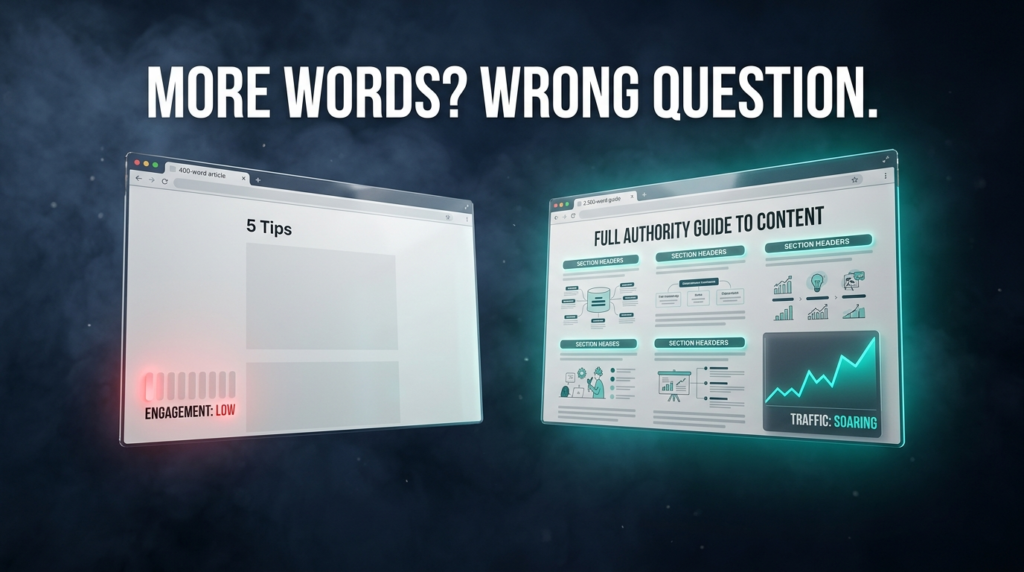
A 500-word article would rarely cover this properly.
Research behind content length and rankings
Several industry studies have shown a correlation between longer content and stronger search visibility. The reason is fairly straightforward.
Longer articles often:
- Cover topics more comprehensively
- Include more relevant keywords naturally
- Generate more backlinks
- Keep users on the page longer
According to research published by Backlinko, pages ranking highly on Google often contain more detailed and comprehensive content.
That doesn’t mean every article should be lengthy. Instead, it highlights the importance of aligning content depth with search intent.
For example:
- A detailed property investment guide may benefit from 2,000+ words
- A short update on Stamp Duty Land Tax changes may only need 700 words
The strongest content strategies understand this balance.
When long-form content works best
Long-form articles perform particularly well when users need education, reassurance or comparison.
Complex decision-making topics
Industries like finance, healthcare and property often involve high-consideration decisions.
For example:
- Choosing a mortgage product
- Comparing pension options
- Understanding property investment risks
Users are unlikely to trust a short article for these topics. They want depth and clarity.
Evergreen educational content
Long-form content is highly effective for evergreen topics that remain relevant over time.
Examples include:
- First-time buyer guides
- Retirement planning resources
- Commercial property investment strategies
These pieces can continue generating traffic long after publication.
Pillar content strategies
Many businesses use pillar content as the foundation of their SEO strategy.
A pillar page acts as a central resource around a broad topic, supported by related subtopics and articles.
For example:
- Pillar topic: “Digital marketing for estate agencies”
- Supporting articles:
- Local SEO tips
- Property listing optimisation
- Social media strategies
This structure helps search engines understand topic authority while improving internal navigation.
Businesses investing in digital strategy services often use this approach to build sustainable search visibility over time.
Why short-form content still has value
Long-form content is not always the best solution.
Shorter articles work well when:
- Users want quick answers
- Topics are time-sensitive
- Information is highly specific
For example:
- “How much is Stamp Duty in 2026?”
- “New FCA regulation updates”
- “Average rental prices in Surrey”
In these situations, users often prefer concise, direct information.
Short-form content also supports:
- News updates
- Social amplification
- Quick engagement
- Faster content production
The mistake many brands make is treating short-form content as lower quality. In reality, short and useful often outperforms long and repetitive.
Balancing depth with readability
One of the biggest challenges with long-form content is maintaining engagement.
Readers rarely consume articles word-for-word. Most scan before deciding whether to continue.
That means long articles must remain easy to navigate.
Here are some effective ways to improve scannability:
Use clear subheadings
Breaking topics into logical sections helps readers find the information they need quickly.
Keep paragraphs concise
Large blocks of text reduce engagement. Shorter paragraphs improve readability, especially on mobile.
Use bullet points strategically
Bullets help simplify:
- Key takeaways
- Processes
- Comparisons
However, overusing them can make content feel fragmented.
Add emphasis carefully
Bold text works best when highlighting genuinely important ideas, not entire paragraphs.
Include relatable examples
Audience-focused examples make complex concepts easier to understand.
For example, explaining how Stamp Duty Land Tax applies at different levels and providing calculated examples for typical purchase prices feels more relatable than simply listing the rates.
This balance between depth and usability is what separates effective long-form content from content that simply feels long.
Creating comprehensive guides without overwhelming readers
Strong comprehensive guides are designed to educate progressively.
Rather than overwhelming readers with dense information, they:
- Build understanding gradually
- Anticipate user questions
- Maintain momentum throughout
A useful structure often includes:
- Overview of the topic
- Key challenges or opportunities
- Practical examples
- Actionable insights
- Strategic recommendations
For example, a guide on financial planning for first-time landlords could move from buy-to-let mortgage considerations to tax implications and tenant management in a logical sequence.
This keeps readers engaged while increasing perceived expertise.
Using content distribution strategically
Even the strongest article has limited value if nobody sees it.
A smart content distribution strategy ensures long-form content reaches the right audiences across multiple channels.
This might include:
- LinkedIn posts
- Email newsletters
- Short-form social snippets
- Supporting blogs
- Downloadable resources
For example, a detailed healthcare industry guide could be repurposed into:
- Short LinkedIn insights
- Infographics
- Email sequences
- Video explainers
This extends the lifespan and visibility of the original content.
Businesses working with an experienced SEO agency in London often use distribution strategies to maximise the long-term value of cornerstone content.
Understanding audience intent before choosing content length
The most effective content strategies begin with one question:
What is the user actually looking for?
Not every search requires a 2,500-word guide.
Before deciding on content length, consider:
- Is the topic informational or transactional?
- Does the audience need detail or speed?
- Are users comparing options or seeking a quick answer?
For example:
- Someone researching pension planning likely needs depth
- Someone checking average rent prices wants efficiency
Content performs best when it respects the audience’s expectations.
This is why successful strategies prioritise relevance over arbitrary word counts.
Building a smarter content strategy over time
Long-form content remains one of the strongest tools for building authority, visibility and trust online. But it only works when paired with clear intent, strong structure and genuine value.
The goal is not simply to create longer articles. It is to create the right content for the right audience at the right stage of their journey.
Businesses can create content ecosystems that support both search visibility and audience engagement by balancing:
- Content length
- Content depth
- Readability
- Distribution
- User intent
Looking to enhance your content strategy?
If you’re reviewing your current approach to content or exploring how long-form strategies fit into your wider goals, it may be worth assessing whether your existing content truly matches the expectations of your audience.
Looking to explore how a more structured approach to content creation could support long-term growth? Talk to Figment about how your strategy could evolve.