For years, winning at search was relatively easy to understand.
You wanted to be on page one of Google. Better still, in the top three. And if you could claim that coveted number one position for an important search term, you were doing something right.
Rankings became one of the clearest measures of SEO success. Higher rankings meant greater visibility, which meant more opportunities for people to click through to your website.
That logic hasn’t suddenly stopped applying since AI appeared on the search scene. Google still matters enormously, and ranking highly for the right searches remains valuable.
But search itself no longer always looks like a list of links.
Google’s AI Overviews and AI Mode can synthesise information from multiple sources into an answer.
Ask the same question in ChatGPT, Claude, Perplexity or Gemini and you may get an answer without seeing anything resembling a traditional search results page.
Sometimes you’ll be shown or cited as a source. Sometimes someone will click through to your website. Sometimes your expertise may help shape an answer without producing a visit you can easily identify.
So if being number one is no longer the only way to be visible, what does winning at search actually look like now?
For years, everyone knew what winning in search looked like.
The traditional search journey was reassuringly straightforward.
Someone typed a query into Google. Google produced a search engine results page. The user chose a result and clicked through to a website.
For businesses, the objective was obvious: get as close to the top of that page as possible.
And for marketers, rankings gave us something tangible to measure and report. If a client moved from page three to page one, or from position eight to position two, everyone could see the progress.
But ranking was never really the end goal.
The business wanted the person behind that search to visit the website, find what they needed and ultimately do something valuable: make an enquiry, book an appointment, request a quote or buy a product.
Ranking was an important route to that outcome. Over time, though, it became very easy to treat the ranking itself as the win.
That’s the distinction that matters now.
Because as the way people search changes, where you appear is becoming only one part of the story.
Search isn’t always a list anymore
The familiar search results page hasn’t disappeared. Far from it.
People still search Google, scan the results and click through to websites every day. But that’s no longer the only search journey businesses need to think about.
Increasingly, someone can ask a question and receive an answer drawing on information from multiple sources. They might see businesses mentioned or cited within that answer, follow a link to find out more, or get what they need without clicking anything at all.
That creates an important distinction between being visible and getting the click. We’re already seeing signs of that in our own client data.
For our recent State of AI Search 2026 research, we analysed Google Search Console data from 18 client websites with a full year of comparable data. Between June and September 2026, those sites appeared in Google search results 8% more often than during the same period in 2025, but received 22% fewer clicks.
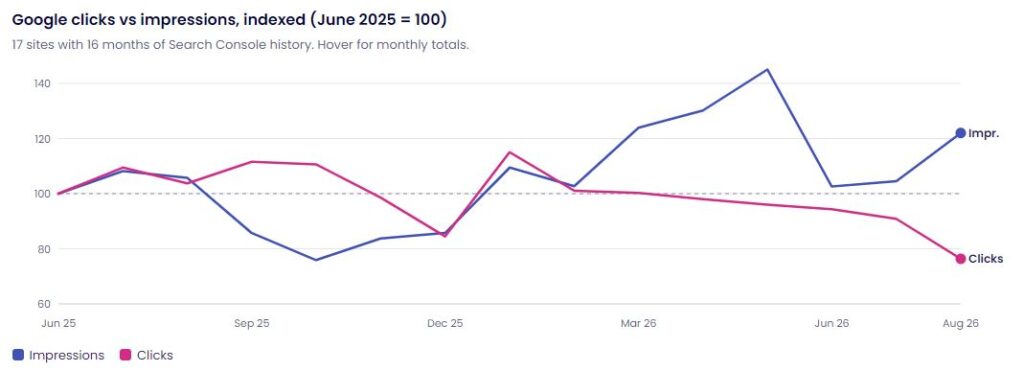
We can’t attribute that entire decline to AI. Some of the websites changed design or URLs during the period, and changes to Google’s search environment also affect parts of the data.
But the wider direction is important.
Appearing more often doesn’t necessarily mean receiving more traffic.
And as search engines increasingly answer questions directly, businesses need to think beyond simply asking where they rank.
Rankings don’t tell the whole story – and neither do citations
There’s another reason we need to look beyond rankings: sometimes performance can improve even when ranking position doesn’t.
We’ve seen this recently with our client, Find My Leisure Vehicle. In August, we rolled out new schema and meta-description templates across all 1,433 of its product pages.
The average ranking before and after the changes remained exactly the same at 10.7. But on like-for-like pages, click-through rates increased by around 10% and clicks increased by 12%.
Same ranking. Better outcome.
It’s a useful reminder of why rankings should never be viewed in isolation. Where you appear matters, but so does how you’re presented, whether someone chooses you and what happens afterwards.
So does AI search simply give us a shiny new metric to obsess over instead?
Before: rank No. 1. Now: be the citation?
Not quite.
Being cited within an AI-generated answer is clearly a useful measure of visibility. It indicates that a platform is finding and drawing upon your content when answering relevant questions.
But a citation isn’t a click, an enquiry or a sale.
Our State of AI Search 2026 research makes that distinction particularly clear.
Three websites accounted for 52% of all the AI citations we tracked, yet only one of those was among the three sites receiving the most AI-referred visitors. Sites with similar citation volumes could receive very different levels of traffic.
That’s why simply replacing an obsession with rankings with an obsession with citations risks making exactly the same mistake with a newer metric.
Both tell us something valuable about visibility.
Neither tells us, on its own, whether that visibility is delivering value to the business.
The traffic may be smaller. But what’s it worth?
If rankings and citations don’t tell us enough on their own, traffic volume doesn’t either.
AI referrals are still a relatively small part of the picture. Across the 21 websites in our State of AI Search 2026 research, around one in every 100 visits came from an AI assistant. That share is growing, but we’re certainly not suggesting that AI is about to replace Google as a major source of website traffic.
What’s more interesting is what those visitors do when they arrive.
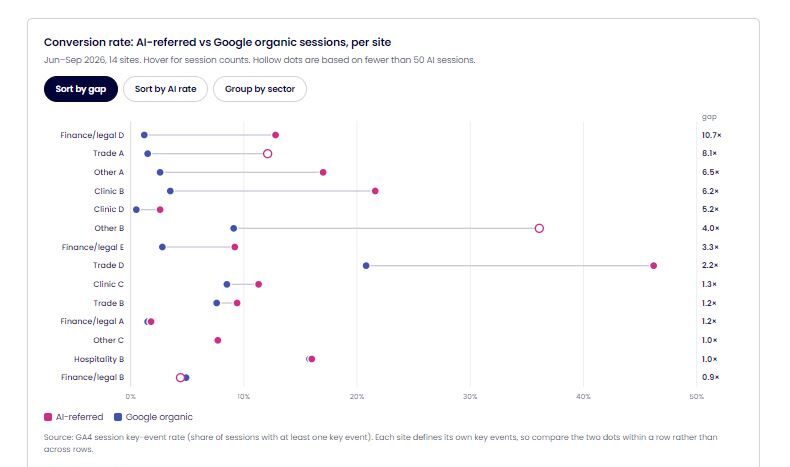
Across the 14 websites where we had enough data to make a meaningful comparison, AI visitors took the actions each site tracks, such as enquiries, calls and bookings, at least as often as visitors from Google organic search on 13 of those 14 sites. Each site tracks different actions, so we compare AI and Google visitors within each site rather than quoting one combined rate.
We’re seeing the same quality-over-quantity story at individual client level.
For The London Orthotic Consultancy, for example, AI visitors converted at 2.5% between June and August 2026, compared with 0.7% for Google organic traffic. New visitors arriving through AI also converted at three times the rate of returning AI visitors.
That doesn’t mean AI traffic will always convert better than Google traffic. We’re looking at a relatively small sample, and different businesses measure different types of conversion.
But it does underline something businesses need to consider as search evolves.
A smaller source of traffic can still have disproportionate commercial value.
If we’re judging success purely by how many visits a channel generates, we risk overlooking the quality and intent of the people behind those numbers.
What does this change about content?
If search engines and AI platforms are increasingly trying to answer questions rather than simply match queries with pages, content strategy has to reflect that.
That doesn’t mean keywords have suddenly become irrelevant. They still help us understand what people are searching for and how they describe their needs.
But keywords alone were never a substitute for knowing your subject.
Businesses need to demonstrate genuine depth and expertise around the topics they want to be known for. That means answering real customer questions clearly, explaining services properly and making it easy to understand who you help, what you offer and why you’re qualified to talk about it.
In other words, being the answer isn’t about creating content for AI. It’s about creating genuinely useful information that AI – and people – can understand and trust.
And that doesn’t only apply to blogs.
Our research found that 42% of AI-referred visits landed on service or product pages and another 34% landed on homepages. Just 12% landed on blogs or guides.
That’s significant because much of the conversation around AI visibility has focused on producing more informational content.
The evidence suggests businesses need to look just as carefully at their core commercial pages.
Do they clearly explain what you do, where you do it, who it’s for, what it costs where appropriate, and what somebody should do next? Those are exactly the kinds of basic questions that need clear answers.
The goal isn’t to produce mountains of content in the hope that an AI platform notices you.
It’s to make your expertise easier to find, understand and use wherever somebody encounters your business.
If ranking isn’t enough, what should we measure?
The customer journey was never as neat as our analytics reports made it look. AI search is making that even more obvious.
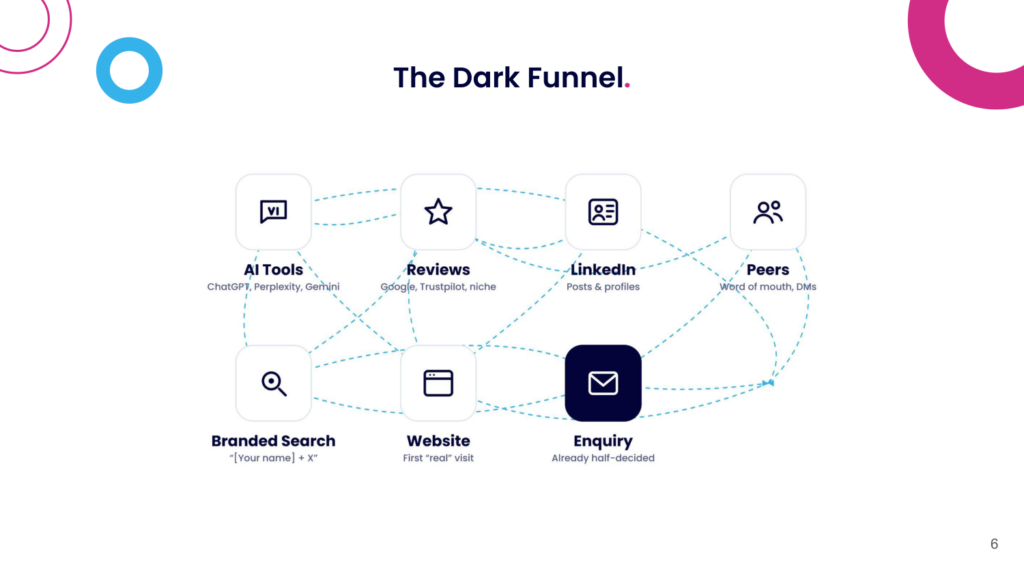
Someone might first discover your business in ChatGPT, see you mentioned somewhere else a few days later, visit your website directly, look at your LinkedIn presence, search your brand on Google and finally come back to make an enquiry.
Which of those interactions deserves the credit?
The truthful answer is that we often can’t know.
Much of that research and influence happens within what’s sometimes called the dark funnel – the part of the customer journey that conventional attribution can’t neatly track.
By the time someone reaches your website and converts through a channel we can measure, they may already have encountered your business several times elsewhere.
That’s why we’ve evolved the way we measure search visibility for our own clients.
Today, all 21 of our active clients have AI visibility measured alongside their conventional Google performance. That includes referral visits from platforms such as ChatGPT, Claude, Perplexity and Gemini, alongside sampled citation data showing how often client websites appear as sources within AI-generated answers. For 15 of those 21 clients, we can also connect AI-referred visits with enquiries.
But the answer isn’t simply to keep adding more metrics to an ever-growing report.
Rankings still matter. So do clicks and organic traffic. Now we can also look at AI referrals, citations and mentions, conversions and, where the data allows it, enquiries and revenue.
Each gives us another piece of the picture.
The question that ultimately matters is much simpler:
Are the right people finding us, and is that visibility contributing to the business?
The new definition of winning at search
So, has ranking No. 1 stopped mattering?
Absolutely not.
But it can no longer tell us everything we need to know about search visibility.
The same applies to AI citations. Being referenced within an AI-generated answer can be valuable evidence that your business is visible and your content is being found and used. But, as we’ve seen, a citation doesn’t necessarily produce a visit, just as a high Google ranking doesn’t necessarily produce a click.
The mistake would be to replace one simple definition of success with another.
Search visibility is becoming more distributed. People can discover, research and evaluate businesses across traditional search results, AI-generated answers and other channels before they ever make themselves known.
That makes measurement more complicated, but the objective hasn’t really changed.
Businesses still need to be found, build trust and ultimately be chosen.
Ranking No. 1 can contribute to that. So can an AI citation. So can a click, a recommendation or an interaction that analytics never manages to attribute properly.
None of them, individually, is the ultimate prize.
Winning in search is no longer about owning one position. It’s about being visible wherever your customers look for answers – and turning that visibility into something meaningful for the business.
Want to be the answer wherever your customers search?
Search is changing, but the fundamentals of building visibility haven’t disappeared. You still need useful content, genuine expertise and a website that makes it clear why customers should choose you.
At Figment, we help businesses build search strategies that work across traditional Google search and the growing AI search landscape – focusing not just on where you’re visible, but whether that visibility is helping to generate meaningful results.
Want to understand how your business is performing as search changes?
Get in touch with our team.