Why compliance matters in financial marketing
Marketing in financial services is not just about creativity. It operates within a framework where accuracy, fairness and transparency are non-negotiable.
Unlike other industries, the consequences of getting it wrong are significant:
- Regulatory penalties
- Reputational damage
- Loss of consumer trust
For businesses in sectors like mortgages, pensions or insurance, compliance is directly tied to credibility.
Think of a first-time buyer searching for mortgage advice. If messaging feels exaggerated or unclear, trust disappears instantly. This is why financial marketing compliance should be built into your strategy from the start, not added as an afterthought.
A structured approach, often guided by a trusted digital marketing agency, ensures that campaigns remain both effective and compliant.
Understanding the UK regulatory landscape
To create compliant marketing, you first need to understand the rules that govern it.
In the UK, financial promotions are primarily regulated by the Financial Conduct Authority (FCA), which sets strict standards for how financial products and services are communicated.
At the core of FCA regulations is a simple principle:
Promotions must be clear, fair and not misleading.
This applies across all channels, including:
- Websites
- Social media
- Email campaigns
- Paid advertising
For example, a pension provider cannot highlight potential returns without equally presenting the risks. Balance is essential.
Working with specialists in SEO for financial services can help ensure that content not only ranks well but also aligns with regulatory expectations.
FCA advertising requirements in practice
Understanding the principle is one thing. Applying it is another.
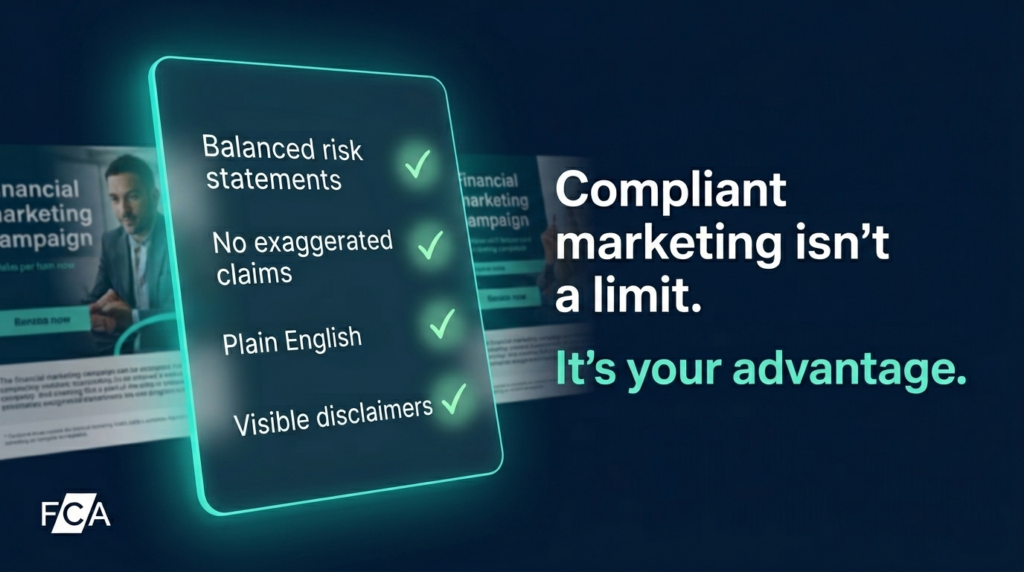
To meet financial advertising rules, your content should:
- Avoid exaggerated claims
Phrases like “guaranteed returns” or “risk-free investment” are not acceptable. - Present balanced information
Benefits must always be accompanied by relevant risks. - Be clear and understandable
Avoid overly technical jargon that could confuse readers. - Target the right audience
Promotions should be appropriate for the intended audience’s level of knowledge.
This is where compliant marketing becomes a skill. It’s about simplifying complex topics without losing accuracy.
For example, a healthcare professional exploring private investment options needs clear, jargon-free explanations rather than complex financial terminology.
The role of disclaimers and risk warnings
Disclaimers are often misunderstood. They are not just legal formalities. They play a key role in protecting both the business and the consumer.
Effective disclaimers should be:
- Visible and easy to read
- Relevant to the content being presented
- Written in plain English
A common mistake is hiding risk warnings in small print or placing them where users are unlikely to notice them.
For example:
- A property investment guide should clearly state that property values can go down as well as up
- An investment calculator should highlight that projections are not guaranteed
When used correctly, disclaimers reinforce trust rather than weaken your message.
Using testimonials and case studies responsibly
Social proof is powerful, especially in financial services. However, it must be handled carefully.
Under FCA regulations, testimonials and case studies must:
- Be genuine and verifiable
- Not exaggerate results
- Clearly indicate if outcomes are not typical
For example, a wealth management firm sharing a client success story should avoid implying that all clients will achieve similar returns.
A better approach is to:
- Focus on the process rather than just the outcome
- Highlight personalised strategies
- Include balanced context
This ensures your content remains persuasive while staying within financial advertising rules.
Aligning marketing with compliance teams
One of the biggest challenges in financial marketing is balancing creativity with regulation.
Marketing teams want engaging content. Compliance teams want risk mitigation. The solution lies in collaboration.
Here’s how to make that relationship work:
- Involve compliance early
Bring them into the planning stage, not just final approval. - Create clear guidelines
Develop internal frameworks for tone, claims and disclaimers. - Use pre-approved messaging
This speeds up content production without compromising compliance. - Educate marketing teams
A good understanding of regulations reduces friction and revisions.
For example, a financial adviser launching a new service can streamline campaigns by aligning messaging with compliance requirements from the outset.
This approach reduces delays and ensures consistency across all channels.
Maintaining performance without compromising compliance
There’s a common misconception that compliance limits marketing effectiveness. In reality, it can enhance it.
Clear, honest and transparent messaging builds stronger connections with audiences.
To maintain performance while staying compliant:
- Focus on clarity over persuasion
Simple, honest messaging resonates more than exaggerated claims. - Use educational content
Guides, FAQs and explainers position your brand as a trusted authority. - Optimise for intent
Align content with what users are genuinely searching for. - Continuously review and refine
Regulations evolve, and so should your content.
Businesses that integrate compliance into their strategy often see better long-term results, especially in high-trust sectors like finance and healthcare.
Partnering with an experienced SEO agency in London can help strike the right balance between visibility and compliance.
Building a compliant marketing strategy that lasts
Financial marketing compliance is an ongoing process that shapes how your brand communicates.
To build a sustainable approach:
- Stay updated with FCA regulations
Regularly review guidance and updates. - Audit your existing content
Identify areas that may need improvement or clarification. - Standardise your processes
Create templates for disclaimers, approvals and messaging. - Measure trust as well as performance
Engagement and conversions matter, but so does credibility.
For example, a pension advisory firm that consistently publishes clear, compliant content is more likely to build long-term client relationships than one focused purely on short-term conversions.
Ready to make compliant marketing work for your financial services business?
Financial marketing compliance doesn’t have to be a barrier. When approached strategically, it becomes a foundation for trust, credibility and sustainable growth.
By aligning your marketing with FCA regulations, refining your messaging and working closely with compliance teams, you can create campaigns that are both effective and responsible.
If you’re reviewing your current approach or planning your next campaign, it’s time to explore how your strategy balances performance with compliance.
At Figment, we work closely with a range of businesses in the financial services sector, and would be delighted to help guide you towards your growth goals. Why not get in touch and let’s talk about how we can support your next steps?