Something interesting has happened over the past few months.
We’re seeing renewed interest in SEO. Businesses that had previously paused activity are coming back to the conversation.
At the same time, we’re hearing more questions about paid advertising. One prospect recently told us they’d switched their ads off after running them for years. Another wanted to test PPC with a budget so small it raised a different question altogether: are businesses becoming less confident about where to invest their marketing spend?
Then there’s AI.
Three of our most recent clients first discovered Figment through AI platforms such as Claude. A year ago, that simply wasn’t happening.
At first glance, these might sound like unrelated observations.
They’re not.
They’re all symptoms of the same thing.
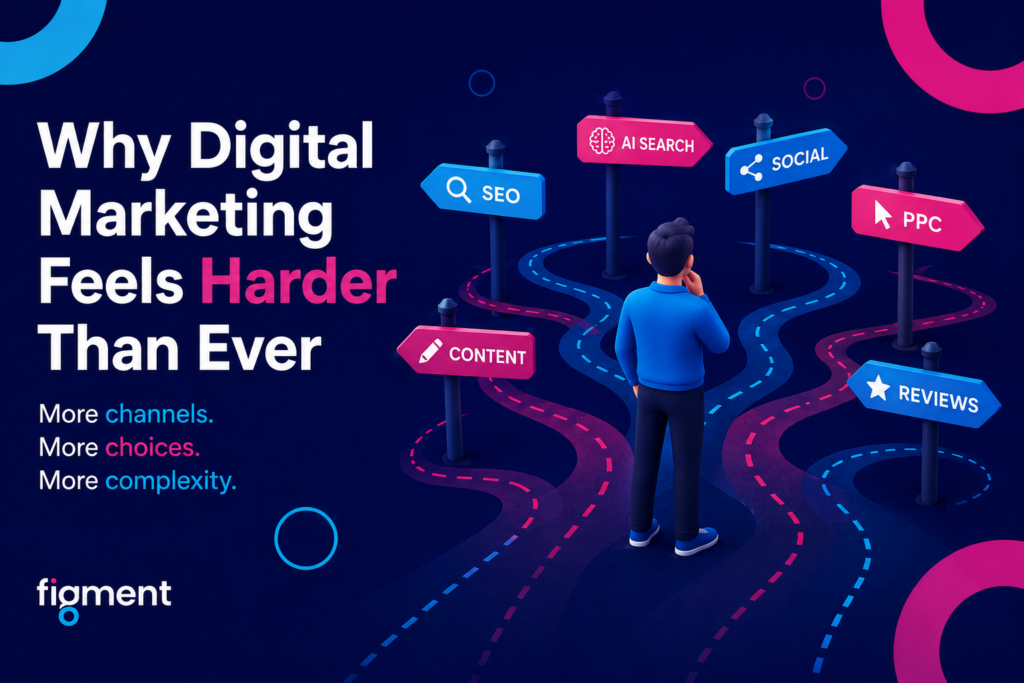
Digital marketing feels more complicated than it used to.
There are more channels. More content. More competition. More ways for people to discover your business. At the same time, budgets are under pressure and AI is changing how information is found, consumed and trusted.
For business owners and marketing leaders, that creates a difficult challenge.
Which channels deserve investment? What still works? What should you ignore? And how do you stay visible when the rules seem to be changing every few months?
The good news is that marketing hasn’t stopped working.
But it has become more interconnected than ever before.
And understanding that shift is becoming one of the most important competitive advantages a business can have.
The old rules were simpler
Let’s be clear: digital marketing has never been easy.
Building a website, creating content, improving search rankings and generating enquiries has always required time, effort and investment.
But the path from discovery to enquiry was generally easier to understand.
A business might build a website, improve its visibility in Google, run some paid advertising, and generate leads through a relatively small number of channels.
There were fewer moving parts.
If someone needed a product or service, they would typically search for it, review a handful of websites, and make a decision.
The challenge was standing out.
The process itself was comparatively straightforward.
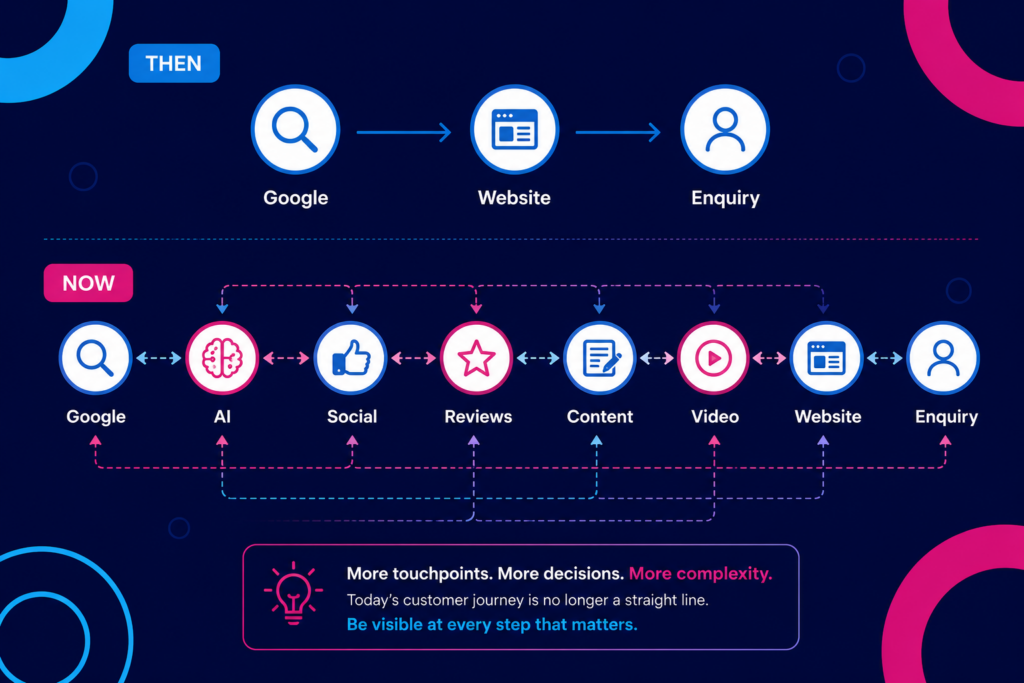
Today, that journey looks very different.
A potential customer might discover your business through Google, encounter your content on LinkedIn, read reviews, watch a video, ask ChatGPT for recommendations, compare alternatives, and then return weeks later when they’re ready to enquire.
The buying journey hasn’t disappeared.
It’s expanded.
And with every new platform, channel and source of information, the number of decisions facing marketers has increased.
That’s one of the main reasons digital marketing feels harder than it used to.
Not because the old methods stopped working.
But because they’re no longer the whole picture.
The new reality: more channels, more decisions
The challenge isn’t that traditional marketing channels have stopped working.
It’s that they’ve been joined by a growing number of new ones.
Today’s buyers can discover businesses through search engines, AI platforms, social media, online communities, video content, reviews, PR coverage, industry publications, podcasts and countless other sources.
And they often do.
People no longer move neatly from search to website to enquiry.
They jump between platforms, compare information from different sources, and build trust over time.
A prospect might first discover a business through Google, encounter their content on LinkedIn, ask ChatGPT a related question, read reviews, watch a video, and only then visit the website.
This is something I explored in my recent article on the 7-11-4 rule, which suggests buyers need multiple interactions across multiple platforms before they’re ready to act.
The key point is that visibility has become fragmented.
Being visible in one place is no longer enough.
A strong Google ranking is valuable. So is a social media presence. So is being referenced by AI platforms. So are reviews, case studies and recommendations.
The challenge for businesses is that every additional channel creates another decision.
- Should you invest more in SEO?
- Should you focus on AI visibility?
- Should you create more content?
- Should you increase ad spend?
- Should you prioritise LinkedIn, YouTube, PR, or something else entirely?
It’s no surprise that many business owners feel overwhelmed.
The modern marketing landscape offers more opportunities than ever before.
But it also demands more choices.
Why we’re seeing SEO make a comeback
One of the more interesting trends we’ve noticed recently is renewed interest in SEO.
For a while, much of the digital marketing conversation centred around AI. Would search disappear? Would websites become less important? Would traditional SEO become obsolete?
Yet our own experience tells a different story.
Businesses that had previously paused activity are returning to the conversation.
Prospects who had taken a wait-and-see approach are looking again at how they appear in search results, AI-generated answers, and across the wider digital landscape.
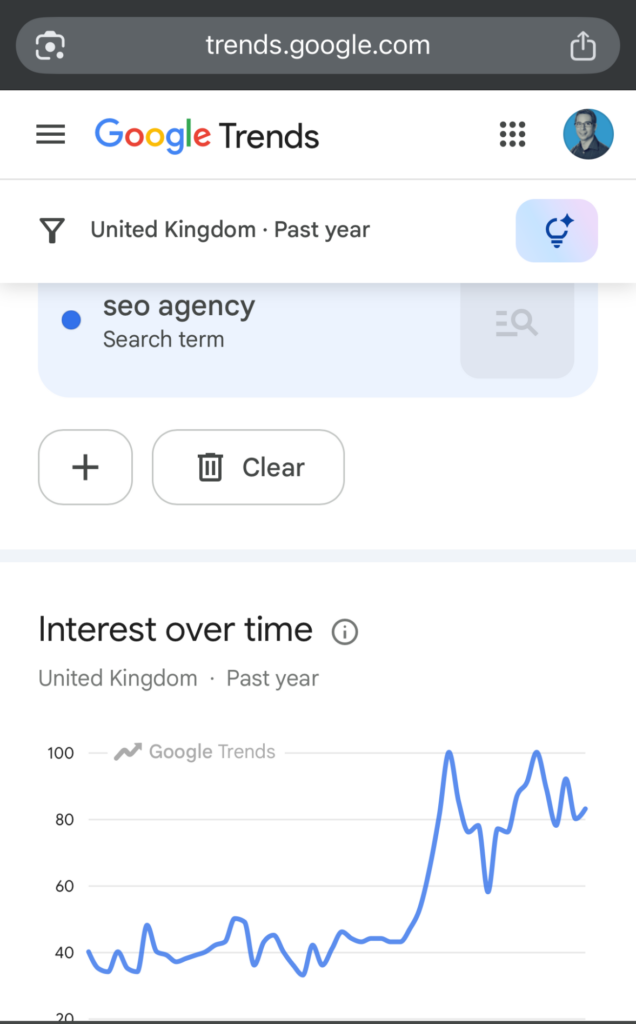
Even broader trend data appears to support this shift. Interest in the term “SEO agency” has risen significantly over the past year, suggesting that businesses are actively reassessing how they approach online visibility.
What’s particularly interesting is that this renewed interest appears to be happening because of AI, not despite it.
As AI search platforms such as ChatGPT, Claude and Gemini become more widely used, businesses are beginning to recognise that visibility still matters. In fact, it may matter more than ever.
The difference is that discoverability no longer begins and ends with a Google search.
Today, businesses need to think about how they appear across traditional search results, AI-generated answers, social platforms, industry publications, reviews, and other trusted sources.
This is where concepts such as GEO (Generative Engine Optimisation) are gaining traction. Businesses aren’t replacing SEO with AI visibility strategies. They’re expanding their approach to reflect how people now find information.
AI hasn’t replaced discoverability. It’s changed how it works.
And the businesses that understand that shift are often the ones gaining a head start.
The PPC question nobody wants to ask
Alongside renewed interest in SEO, we’ve noticed another trend emerging in conversations with prospects.
More businesses are questioning their paid advertising spend.
Not because PPC has suddenly stopped working.
And not because businesses have lost faith in digital advertising altogether.
Instead, we’re seeing a growing sense of caution.
One prospect recently told us they had switched their ads off after running campaigns for years. Another wanted to explore PPC but with such a small test budget that it raised a different question entirely: was the hesitation really about budget, or about confidence?
That’s an important distinction.
When marketing budgets are under pressure, every investment comes under greater scrutiny. Businesses want to know what’s working, what isn’t, and where they should focus their efforts.
The challenge is that there are fewer straightforward answers than there used to be.
Search has evolved. AI has entered the picture. Organic visibility is changing. Customer journeys are becoming more fragmented.
As a result, businesses are naturally asking tougher questions.
- Does PPC still work?
- Should we invest more in SEO?
- What role does AI search play?
- Where are our customers actually finding us?
These are all valid questions.
But they’re often symptoms of a bigger concern: uncertainty.
The issue isn’t whether PPC works. For many businesses, it absolutely does.
The issue is confidence.
Confidence that you’re investing in the right channels. Confidence that your marketing strategy reflects how people actually discover and evaluate businesses today. Confidence that your budget is working as hard as possible.
And in a more complex marketing landscape, confidence can be surprisingly difficult to find.
Warning: more content doesn’t mean more visibility
If there’s one thing AI has made easier, it’s content creation.
Businesses can now produce blog posts, social content, emails and marketing materials faster than ever before.
On the surface, that sounds like a positive development.
But it creates another challenge.
If everyone can create more content, everyone does.
Which means businesses are competing against a growing volume of articles, videos, social posts, AI-generated answers and marketing messages.
The result is more noise.
And more competition for attention.
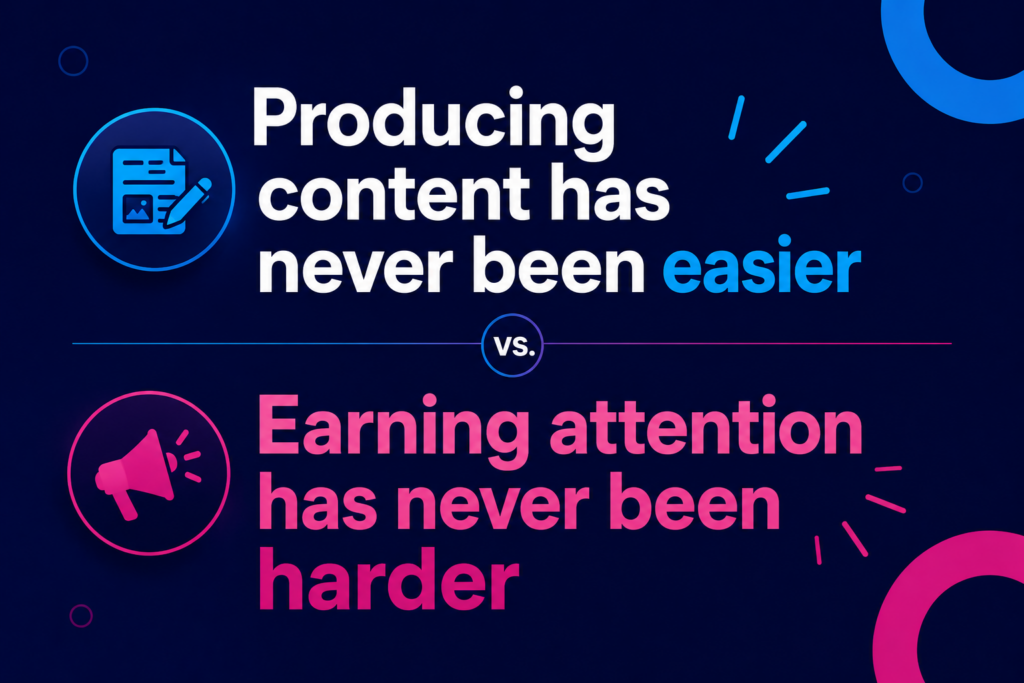
Producing content has never been easier.
Earning attention has never been harder.
This is another reason digital marketing can feel more challenging than it used to.
Success isn’t simply about publishing more.
It’s about creating content that demonstrates expertise, answers real questions, and provides genuine value to the people you’re trying to reach.
Increasingly, that means drawing on the knowledge and experience that already exists within your business. In a world where anyone can generate content, authentic expertise has become a powerful differentiator.
Just as importantly, it’s about making sure that content is actually seen.
Many businesses focus heavily on content creation but spend very little time thinking about content distribution. Yet a great piece of content that nobody sees won’t generate visibility, trust or enquiries.
That’s why the conversation shouldn’t be about producing more content.
It should be about producing better content, distributing it effectively, and building authority over time.
Because visibility isn’t created by volume.
It’s created by relevance, consistency and trust.
What actually works NOW
Faced with more channels, more content and more choices, it’s tempting to look for a silver bullet.
A new platform.
A new tactic.
A new piece of technology.
But the businesses that navigate complexity most successfully rarely do so by chasing every new opportunity.
Instead, they focus on a handful of fundamentals.
- Clarity.
- Consistency.
- Authority.
- Distribution.
- Visibility.
Those principles matter just as much today as they did before AI entered the conversation.
The difference is that they’re now being applied across a broader and more interconnected landscape.
That means creating content that demonstrates genuine expertise. It means showing up consistently where your audience spends time. It means making sure valuable content is distributed effectively rather than simply published and forgotten.
Most importantly, it means building authority over time.
Because whether someone discovers your business through Google, LinkedIn, ChatGPT, a recommendation, or an industry publication, they’re ultimately looking for the same thing: confidence that you know what you’re talking about.
That’s why I believe the goal isn’t simply to generate more content, more traffic or more clicks.
It’s to build authority. Build visibility. Be the answer.
The businesses that succeed in the years ahead won’t necessarily be the ones using the newest tools or creating the most content.
They’ll be the ones that make it easiest for people to find, trust and choose them.
Marketing isn’t likely to get easier. But it can become clearer.
It’s easy to see why so many businesses feel uncertain about marketing right now.
The number of channels has increased. The way people search has changed. AI is reshaping discovery. And there are more decisions to make than ever before.
On the surface, it can feel as though the rules are constantly changing.
But while the tools and platforms continue to evolve, the fundamentals remain remarkably consistent.
People still look for businesses they can trust.
They still seek expertise, credibility and reassurance before making a decision.
And they still choose the brands that show up consistently throughout that journey.
That’s why the answer isn’t to chase every new trend, platform or tactic.
It’s to build authority, create visibility, and make it easy for people to find trusted answers wherever they’re looking.
Marketing might feel harder than it used to be. But what’s really happening is that it’s more interconnected than it’s ever been.
The businesses that recognise that shift — and adapt accordingly — will be far better placed to earn attention in the years ahead.
Want to understand what AI search means for your visibility?
Join me for our upcoming webinar, Get Found in AI Search: Be the Answer, where I’ll explore how businesses can improve their visibility across platforms such as ChatGPT, Claude and Gemini, and turn AI search into a genuine source of enquiries.
📅 9 July 2026
⏰ 12:00pm
📍 Online
Feeling overwhelmed by too many marketing decisions?
If you’re trying to decide where to focus your efforts, Figment is here to help. Whether you’re reviewing your SEO strategy, exploring AI visibility, reassessing paid advertising, or simply trying to make sense of a changing landscape, we’ll help you identify the opportunities that matter most to your business.