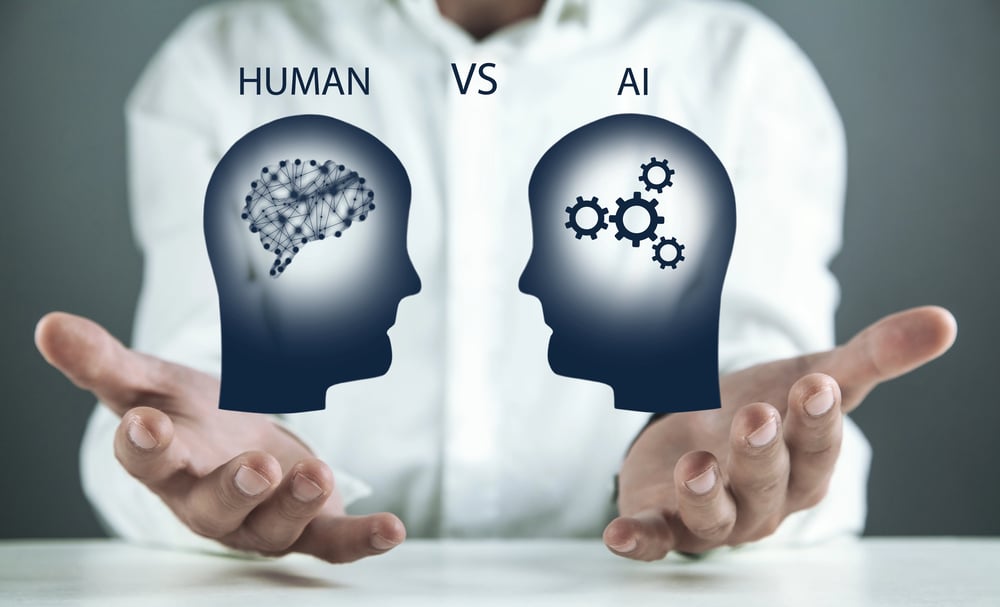
There is no denying it: AI has changed the game. With the rapid rise of tools like ChatGPT, Gemini, Jasper and others, the content landscape has been shaken to its core. In a matter of seconds, anyone can now generate blog posts, product descriptions, social media posts — even complete e-books and whitepapers — with just a few prompts and a click of a button.
And that’s exactly what a lot of businesses are doing.
We get it. It’s fast. It’s cheap. It sounds pretty convincing. So it’s no surprise that when we talk to new clients about content writing, one of the most common responses we hear is:
“Oh, we’re using AI now — we’ll just write it ourselves.”
It’s the classic “I’ve got a camera, so I must be a photographer” mindset. And while AI absolutely has its place in a modern marketing strategy — we won’t deny using it ourselves here at Figment — it has to be said that it’s not the magic bullet that some businesses believe it to be, especially for brands working with a London SEO agency to build long-term authority.
AI can structure content. It can echo tone. It can help you get started. And these days, it’s sounding scarily convincing.
But it can’t replace real-world experience, human nuance or the insight that only comes from the first-hand knowledge of the people behind the brand.
And that’s why we’re writing this article. To delve into the real differences between AI-generated content vs human content, and why we believe the smartest strategy is not to choose one over the other, but to combine both.
We’re looking at:
- How AI performs compared to human writing
- Where AI shines (and where it falls flat)
- What Google really wants when it comes to quality content
- The risks of relying on AI alone
- How a hybrid approach leads to better performance
- Why working with a human specialist writer is still the best way to gain trust, rankings and results
Let’s dive in.
AI-generated vs human generated content: At a glance
On the surface, AI-generated content looks like a fast, efficient solution to a long-standing marketing challenge. It can write entire blogs in seconds. But dig deeper, and the performance gap between human and AI content becomes clear.
In a recent study by Neil Patel of NP Digital, human-written content generated 5.44 times more traffic than AI-generated content. That’s a powerful reminder that while AI can produce words, it’s the human touch that truly connects with readers — and search engines.
Here’s a quick side-by-side comparison:
| Factor | Human-Generated Content | AI-Generated Content |
| Tone & Voice | Tailored, nuanced, brand-aligned | Can mimic tone, but is often generic or inconsistent |
| Accuracy | Fact-checked, based on experience or primary sources | Relies on training data; risk of outdated info |
| Creativity | Original ideas, storytelling, humour | Limited to remixing existing patterns |
| Contextual Insight | Understands current events, cultural nuances and communication styles, client specifics | Lacks situational awareness |
| Effort & Time | More time-consuming, but highly considered | Fast output, minimal input |
| Cost | Higher investment, but higher return | Low-cost (at first glance) |
| Risk | Low – controlled, accountable, brand-safe | Higher – hallucinations, repetition, compliance risk |
💡 Key takeaway: AI can certainly support the content process, but relying on it exclusively may cost more in the long run — especially when traffic, trust and conversions are on the line.
The case for AI content: where machines shine
Let’s not pretend AI hasn’t changed the game. Tools like ChatGPT, Gemini and Claude are incredibly powerful — and when used right, they can save time, improve structure and speed up content production.
At Figment, we’re definitely not anti-AI. We use it strategically, weaving it into our workflows where it makes the most sense.
For us, here’s where we think AI really shines:
✅ Speed
AI can generate a basic blog structure or summary in seconds. For early-stage research or outlining, it’s a genuine time-saver — especially when deadlines are tight.
✅ Data Crunching
Need a quick list of stats or an overview of a complex concept? AI can pull together the basics fast. That gives our human writers more time to focus on insight and value, rather than Googling for definitions.
✅ Structuring Long-Form Content
Planning a 2,000-word article? AI can suggest headings, break up content logically and even spot flow gaps. It helps us spot angles we might’ve missed — but crucially – we then make it human.
✅ Brainstorming Ideas
Whether it’s blog titles, FAQs or topic clusters, AI is brilliant for brainstorming. It won’t give you a fully formed idea — but it’s a great way to spark new directions or sense check concepts you’ve formed in your own mind.
✅ Drafting FAQ Sections or Summaries
For certain content formats — especially FAQ blocks or summary intros — AI can give us a strong first draft. We’ll then edit for tone, relevance and accuracy, making sure it matches the client’s goals.
How we use AI at Figment:
- Mapping out article structures before we write
- Researching keyword variations or title formats
- Summarising complex technical explanations into plain English
- Generating first-draft content that we can enhance with real client insights
We don’t see AI as the answer to every writing challenge. But when you know where it fits – and where it doesn’t – it’s a powerful addition to the digital content toolbox.
Does AI content actually rank?
The question on every marketer’s mind:
👉 Does AI content rank in search engines?
The short answer? Yes — it can.
Google crawls, indexes, and ranks AI content. According to Google, “if [AI content] is useful, helpful, original, and satisfied aspects of E-E-A-T, it might do well in Search. If it doesn’t, it might not.”
But (and this is important) performance depends on how it’s used.
✅ What the research shows:
Neil Patel’s study found that AI-generated content was indexed and ranked by Google. But it performed 5.44 times worse in traffic terms compared to human content.
Google’s own guidance states that AI-generated content isn’t inherently against guidelines — as long as it’s helpful, original, and high quality.
So yes, AI content can rank. But if it’s generic, repetitive or lacks experience-driven depth, it’s unlikely to stay there — especially in competitive industries like finance, healthcare and law, where EEAT signals matter most.
At Figment, we’ve seen this play out first-hand. Pages with well-researched, expert-informed, human-authored content consistently outrank templated AI pieces.
Why? Because the human input delivers value, not just volume.
The human writer edge
AI can structure, summarise and speed things up. But when it comes to empathy, originality and experience — that’s where the human writer always wins.
Specialist writers bring something AI simply can’t replicate: lived understanding.
AI hasn’t worked cases in court. It hasn’t sat across the table from a client navigating a life-changing diagnosis. It hasn’t visited a holiday destination, heard the birdsong from the balcony or tasted the paella.
But your audience expects that kind of depth. That’s where specialist human writers come in. This is what they bring to the table:
🧠 Emotional Intelligence
Whether it’s writing about IVF treatment with compassion, or speaking to time-poor landlords with wit and precision, tone matters. Human writers can adapt their voice, inject warmth or urgency, and choose language that truly connects.
📚 Situational Awareness
A property investment blog needs to reflect current market conditions. A finance article needs to stay within FCA compliance guidelines. Healthcare content must balance clarity with medical accuracy. Humans understand this — and know when a line of copy goes too far (or not far enough).
💡 Real Insight
At Figment, we don’t just write. We interview, research and collaborate. That means things like:
- Asking a fertility specialist about their most common patient questions
- Chatting with a hotel owner to get real feedback on the best family-friendly activities and brunch spots near Bloomsbury
- Understanding what truly matters to financial planning clients – like knowing their retirement plans are on track, or that they’ll be in a position to fund their child’s education. This genuine understanding enables the writer to get that underlying emotion across.
These are insights you can’t Google. And they certainly don’t come from AI’s training data.
🎯 Original Storytelling
Human writers can tell stories that connect with real people. Whether it’s a blog about a client’s success, a guide that addresses reader pain points, or a landing page that anticipates what someone’s thinking before they think it — humans create content that feels written for you, not for an algorithm.
AI can’t ask follow-up questions. It can’t interpret tone in a Zoom call. It can’t pick up on your client’s subtle frustrations or lightbulb moments. That’s where human writers have the edge.
EEAT: Why Experience is the New Differentiator
You’ve probably heard of E-A-T – Google’s acronym for Expertise, Authoritativeness, and Trustworthiness. But in late 2022, Google added an extra E to the front. It now stands for:
👉 Experience
👉 Expertise
👉 Authoritativeness
👉 Trustworthiness
Why the extra letter? Because lived, human experience matters more than ever.
Let’s break it down:
🧭 Experience
This is about first-hand involvement. Has the content been written by someone who’s done the thing they’re talking about?
- A healthcare blog written by a content writer who has actually interviewed a consultant, not regurgitated NHS leaflets
- A property buying guide that includes inside tips from an agent who’s helped hundreds of buyers navigate the London market
- A travel blog recommending a Sunday market – because the owner has actually been there and had the cake
🤓 Expertise
Do they know what they’re talking about – and can they back it up? This applies especially in regulated sectors like:
- Healthcare – content written or reviewed by clinicians
- Finance – guidance from qualified advisers, not AI guesswork
- Legal – articles informed by real-life case experience and legislation
🏛 Authoritativeness
Google looks for signals of credibility:
- Are you known in your space?
- Do others reference your content?
- Are your bios and credentials clear?
This is where good content meets strong SEO – strategic internal linking, schema markup and citation building all help demonstrate authority.
🔒 Trustworthiness
Can readers trust what you’re saying?
- Are sources cited?
- Are stats accurate?
- Is the content free of hallucinations, over-promises or bias?
And here’s the kicker: AI struggles with all of this. It hasn’t lived your experiences. It doesn’t know your industry inside out. It can’t back up its claims with original research or first-hand interviews. And Google knows it.
Why AI can’t fake EXPERIENCE (yet) – and Google knows it
Let’s be honest: AI can sound convincing. But when it comes to EEAT — especially the Experience bit — it falls short.
💡 AI hasn’t lived your life, worked your job, or spoken to your clients.
It hasn’t walked through a property, sat with a patient, advised someone on retirement planning, or gone behind the scenes at your business. It can imitate knowledge, but it can’t fake experience — not convincingly, and not consistently.
And Google’s algorithms are getting better at spotting this.
AI-written content often:
- Lacks specificity
- Repeats common phrases or generic advice
- Misses nuance and tone
- Fails to reference real-world examples or cite credible sources
Google uses signals — like author bios, backlinks, structured data and even user behaviour — to determine whether your content has that lived, useful edge.
So where does the human writer come in?
Human writers can help clients demonstrate EEAT in all their content. Here’s how we do it at Figment:
✅ We interview subject matter experts to bring lived experience to the page
✅ We fact-check and cite credible sources
✅ We structure content for authority using smart SEO techniques
✅ And we write in a way that builds trust – with both your audience and Google
The risks of AI-only content
AI can churn out content at lightning speed. But speed doesn’t always equal success — especially when the content in question is riddled with issues that could harm your credibility, mislead your readers or damage your rankings.
Let’s break down the risks of relying on AI alone.
⚠️ Inaccuracies and Hallucinations
AI tools like ChatGPT don’t access the live web. Instead, they generate responses based on patterns in the data they’ve been trained on — which may be outdated, incomplete or just plain wrong.
They also hallucinate — a known phenomenon where AI invents facts, quotes or sources that don’t actually exist. In regulated industries like healthcare or finance, this isn’t just embarrassing — it could land you in a lot of compliance trouble.
📉 Lack of Source Credibility
Not all AI tools will tell you where a stat came from unless you specifically ask — and even then, it might not cite a real source. That’s a problem if you’re publishing content that needs to be trusted, fact-checked and referenced.
😴 Samey, Overused Phrasing
Because AI is trained on vast volumes of web content, it tends to recycle popular phrasing — and that means much of the output sounds the same.
The result?
- Bland intros
- Repetitive sentence structure
- Overuse of tired hooks like “In today’s fast-paced world…”
All this might be OK for filler content – but it’s not good at all if you’re trying to stand out as an expert in your niche.
🤦♀️ Missed Nuance, Context and Relevance
AI doesn’t understand your customers or clients. It doesn’t know your tone of voice, your brand values, or the context behind your messaging. And it certainly doesn’t know what your audience is asking during consultations or what matters most to them when choosing your services.
Yes you can train it to write in a certain tone, and it’s getting pretty good at that. But weaving in underlying messaging, values and context is a human skill that AI struggles to match.
✍️ Real Example: The Human Edge in Action
Recently, we used AI to assist with a blog outline for a Figment client. The result was a decent structure and some helpful points — but it missed a crucial issue that real customers were actively asking the business about.
Because we’d worked closely with the client — and conducted interviews with their team — we knew that this missing topic was actually one of the top concerns for their audience.
So we added it in. Expanded on it. Provided examples.
That’s the difference a human writer makes.
AI is powerful — but it doesn’t know what your customers are saying on the phone, asking at consultations, or hesitating about before they buy. We do.
Hybrid wins: The power of AI + human writers
At Figment, we are not in any way anti-AI. But we are pro-results.
We believe AI is a powerful tool — but it’s just that: a tool. Like spellcheck, Grammarly or Google Docs, it’s useful, but not a replacement for the human thinking behind the message.
The most effective content today? In our opinion, it’s crafted by humans, supported by AI. And that’s exactly how we work.
🧠 AI for Efficiency, Humans for Impact
We use AI to:
- Speed up research – especially when summarising complex topics
- Generate initial content structures – saving hours in the planning stage
- Brainstorm headline ideas – perfect for A/B testing or inspiration
- Summarise FAQs or process steps – freeing up time for deeper work and client interviews
But that’s only the beginning.
✍️ Where the Human Writer Comes In
Once the foundation’s laid, our specialist writers go to work. They:
- Interview clients to extract first-hand insights and real-life stories
- Pose as the client or customer, and ask the questions they are actually asking
- Add tone, warmth, wit and personality
- Ensure factual accuracy and context
- Tailor content to reflect lived experience — not just “what’s out there”
This hybrid workflow gives you the best of both worlds:
⚡ Speed and structure from AI
💡 Insight and originality from a professional writer
💬 Real-World Example
Say we’re writing a blog for a private clinic. We might:
- Use AI to sketch out the structure – headings, basic explanations, FAQs
- Conduct an interview with the clinic’s lead specialist to capture insight into how they handle a specific treatment or concern
- Blend these real quotes and expert context into the AI-generated structure
- Refine the tone and polish the content to reflect the clinic’s brand voice
The result?
A well-researched, SEO-friendly article that ranks and resonates.
AI makes us faster.
Human creativity makes it matter.

Real world examples from Figment
At Figment, we don’t just talk about content rooted in real-world experience — we write it, every single day.
Here’s how our human-led approach creates content that truly connects, engages and performs across a range of industries:
🏨 Hospitality: Local Insight That Only Humans Can Offer
For a boutique hotel in Bloomsbury, we regularly interview the owner, Simon, to get personal recommendations for the best places to eat, visit, and explore. His daughters — self-confessed brunch aficionados — helped shape our blog, The Best Places for Brunch in Bloomsbury, with first-hand tips that no AI tool could guess.
🧠 Why it works: AI can tell you where a lot of people go. A human can tell you where to go next weekend — and what to order.
👩⚕️ Healthcare: Specialist Experience at the Core
We regularly collaborate with medical clients — including fertility clinics and regenerative medicine specialists — to craft blog content grounded in clinical expertise.
For Hull & East Riding Fertility, a private fertility clinic, we tap into the expertise of various clinical leads to inform content around sensitive and complex treatments, such as andrology and diagnostic hysteroscopy.
And for Stemwell, an international stem cell therapy clinic, our content strategy focused on educating readers on specific treatments and the conditions they target — to attract a diverse pool of potential patients through relevant search terms.
🧠 Why it works: No AI can replace a clinician’s lived insight. But a skilled writer can capture it, translate it, and share it meaningfully with patients.
💰 Finance: Real Conversations with Real-World Relevance
For our financial services clients, we go beyond generic “money tips” and get to the heart of what their clients really care about. Whether it’s helping their children through university or achieving early retirement, these deeply personal goals shape the content we write.
We interview financial planners to understand their process, the reassurance they provide, and the questions their clients ask most — weaving all of this into audience-specific content (aimed for example at business owners, medical professionals or women) that’s designed to build trust and demonstrate true understanding.
🧠 Why it works: Money is personal. AI can’t replicate empathy or translate complex advice into calming reassurance — but a human can.
🚐 Leisure: First-Hand Experience, Not Just Reviews
Online leisure vehicle guide Find My Leisure Vehicle looks to attract buyers of motorhomes, campervans and caravans. This type of audience is eager to absorb real-life reviews and insider tips. So when writing their blogs, we’re sure to tap into the wealth of experience offered by their industry experts.
- Top Hidden Gems for UK Motorhome and Caravan Owners
- Winter Camping: Best Motorhomes for Cold Weather
- Motorhome and Caravan Accessories You Can’t Live Without
Each piece includes first-hand input (and in some cases, photos) from real enthusiasts and product users, so readers know they’re getting authentic, experience-driven guidance — not recycled ideas.
🧠 Why it works: AI might tell you what should work. A real person tells you what actually does.
These examples all have one thing in common:
✨ They’re written by humans who know how to ask the right questions, connect with the right people, and turn raw insight into readable, relatable content.
When you partner with Figment, you’re not just getting “SEO copy”. You’re getting experience, empathy and originality — and that’s what makes content perform.

Final thoughts: Who should you trust with your content?
AI has changed the game — there’s no denying it. It’s fast, accessible, and powerful. Used wisely, it can absolutely help streamline your content creation process.
But… when it comes to content that builds trust, ranks competitively, and connects with real people, the human touch still wins.
AI can give you a head start. But humans still finish the race.
At Figment, we believe in combining the best of both worlds:
- AI tools for structure, speed, and insight
- Human writers for originality, relevance, and real-world experience
Our content team works closely with clients to create copy that sounds like them, adds value to their audience, and meets Google’s EEAT criteria. From healthcare to finance, hospitality to property, tech and lifestyle, we make content work — in all the right ways.
👉 So if you’ve been wondering whether it’s worth hiring a content specialist when ChatGPT exists, here’s the answer:
You don’t just need content. You need content that performs. And that performance depends on more than great writing alone. Working with experienced SEO specialists in London — and with an eye on AI search optimisation ensures your content is strategically optimised, aligned with Google’s latest updates, and positioned to drive real, measurable results. Let’s talk about what that looks like for your business.