Update: As of 15th May 2024, Google’s Search Generative Experience (SGE) has changed to “AI Overviews and more” (Source).
The idea behind Google SGE is to use artificial intelligence (AI) to generate dynamic content directly within the search results page. This will allow users to engage with information in new ways, without having to click through to external websites.
For example, in place of static lists of search results, Google generative AI search could present interactive elements. These could be the likes of graphs, sliders or other visual elements that allow users to explore data directly on the search results page.
For those users who wish to quickly analyse and compare information without leaving the results, SGE could become a new best friend.
But of course, any form of change in the search landscape is always going to throw up the same question: will it change the way we approach SEO? And this is what we’ll be exploring in this post, along with:
- When will Google SGE be available for general use?
- How does Google generative AI search work?
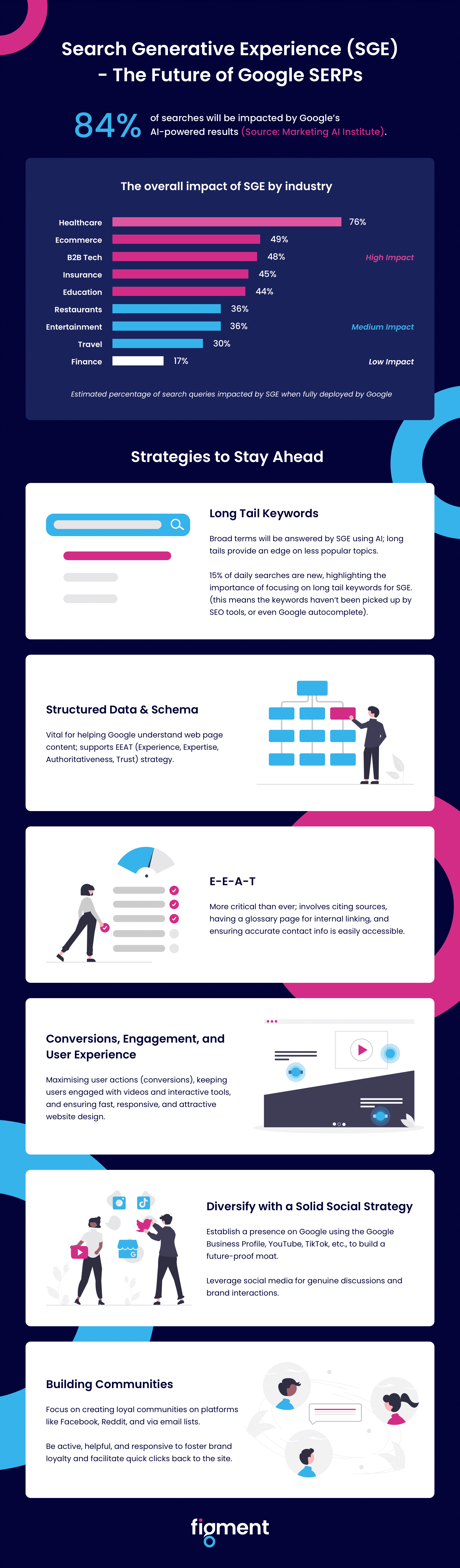
- How will Google SGE impact search results and organic traffic?
- How to prepare for Google SGE from an SEO perspective?
- How to optimise a website for Google generative AI search?
When will Google SGE be available for general use?
Google SGE is currently in its beta testing phase and available via Search Labs in certain countries only, excluding the UK at the time of writing this post. It’s anticipated that it will arrive here by March 2024.
The experiment was extended at the end of 2023. This came as something of a surprise within the search industry, especially bearing in mind that Microsoft has already integrated ChatGPT into Bing. But there appear to be good reasons for keeping SGE behind the scenes in Search Labs.
Google sticks by the guiding principle of only using AI once the technology is proven to be successful, and being able to implement it in a way that can be trusted to be responsible. Generative AI is not there yet, so Google SGE will remain in its testing environment for the foreseeable.
However, in the name of staying ahead of the curve, it’s still worth getting to know how this new feature is going to work, and what impact it might have on search and SEO.
How does Google generative AI search work?
SGE Google AI technology uses generative AI to provide quick, clear overviews of search topics, without the need to click on individual web page links.
If you want to glean an overview of a topic without delving into it too deeply; you’re after quick, top line answers, looking for key takeaway summaries or on the search for how-to instructions, then Google SGE will likely prove useful.
It actually works a bit like LLMs such as ChatGPT and Perplexity. Instead of responding to a search query with a list of website links for you to explore individually, Google SGE will give you a summary list of suggestions taken from multiple sources.
The summaries are convenient, because they mean you don’t have to spend valuable time filtering through individual web pages for the answers you need. You might for example want to know the best way to cook a turkey through the night.
Google SGE will scan the web for answers, summarise the best responses, show AI-generated snapshots and images and provide the opportunity to ask a follow-up question.
Here’s a quick overview of the benefits of Google generative AI search:
- Simple overview of in-depth topics
- See logical follow-up queries
- Succinct summaries of multiple results
- Ask follow-up questions
- See citations to check validity/relevancy of results
But there are some downsides too…
We know that AI-driven large language models can sometimes ‘hallucinate’ and return inaccurate information. So there’s always going to be that disclaimer sitting in the shadows, warning you that “info quality may vary”.
If you pose a question under a Your Money or Your Life (YMYL) topic, for example a health related query, then you’re going to see an extra disclaimer stating that the search result “does not constitute medical advice” and encouraging users to seek advice from their medical provider.
As with any information return by an LLM, it’s always going to be essential to double check facts. This is especially important if you searching for education or research purposes.
How will Google SGE impact search results and organic traffic?
There’s no straight answer to this question just yet. There is a distinct lack of meaningful data, and a large number of variables to factor in.
The main concern for website owners is that because responses to search queries are being summarised on the search engine results pages, users will click through to individual sites less frequently.
There’s a lot that will determine how much traffic might be lost to SGE:
- How often AI-driven snapshots show across target keywords
- The speed at which SGE generates snapshots for target keywords
- How far traditional search results are pushed down the page by AI snapshots
- How often users click through citation links
- Whether users will trust the snapshots and summaries, or make the decision to pursue traditional results
But whilst there is the possibility of reduced organic traffic on the cards, Google SGE may well turn the tables with a number of potential benefits that may outweigh this downside:
Higher Quality Traffic
Users who engage with the interactive snapshots generated by SGE are likely to be more informed about the topic when they do visit a website.
This means that when they click through to a site, they are more likely to be genuinely interested in the content and therefore more apt to engage with it, leading to higher-quality traffic.
Increased Engagement and Conversions
Because users who click through to a website after engaging with SGE are already well-informed about the topic, they are more likely to engage with the content on the website and take desired actions, such as making a purchase, signing up for a newsletter, or filling out a contact form.
This can lead to higher conversion rates and a more favourable return on investment for website owners.
Improved User Experience
Google SGE can enhance the overall user experience by providing users with more interactive and informative search results directly on the search results page.
This can help users find the information they need more quickly and easily, which can lead to increased trust and satisfaction.

Brand Visibility and Authority
Even if users don’t click through to a website immediately, the fact that your website is featured prominently in the search results can still help to increase brand visibility and establish your website as an authority on the topic. This can have long-term benefits in terms of brand recognition and reputation.
It’s also important to bear in mind that Google is combining Google generative AI search results with traditional search results rather than replacing anything. Traditional results will still be listed under the AI-generated response. What’s more, only those users who’ve opted in to use SGE will see the AI responses. Others will continue to use traditional search for their research.
What should digital marketers be doing to prepare for Google SGE from an SEO perspective?
It’s too early to tell exactly what strategies will need to be adopted or changes made to SEO campaigns as Google SGE is adopted.
However, digital marketers CAN put an action plan together to prepare for the official dawn of the Google search generative experience:
- Check availability of Google generative AI search in Search Labs and sign up as soon as access is given
- Test Google SGE amongst your team to work out how it operates and analyse the effects it may have on your website(s) – remember that SGE is still in its experimental phase and will keep evolving, so keep on testing to see how things change
- Determine how often AI snapshots appear in search for your target keywords
- Map the frequency of AI snapshots against the various keyword intents (informational, navigational, commercial, transactional)
- Monitor website traffic for any keywords you cite as affected
- Monitor on-page metrics for click-through-rates from any affected keywords to determine any changes in user behaviour
- Check whether total conversions from organic traffic have dropped
- Monitor leads, sales and income that comes from organic traffic to check for any shifts

How to optimise a website for Google Generative AI search?
Again, it’s early days, but initial indications are that the following tactics will make it more likely for a website to appear in the AI snapshot results following a Google generative AI search:
Create content that’s relevant to search intent
The Google search generative experience is all about serving users with content that closely aligns with their search intent and that provides comprehensive, relevant responses. Research shows that SGE can return up to five content modules based on the intent of a query, and each will provide an opportunity to engage with users.
Craft content that’s focused on user engagement
The way in which users interact with online content is becoming more and more important. It’s vital to craft content that goes beyond addressing user queries and promotes added interaction. Google is constantly updating SGE by adding and removing modules based on user engagement levels.
Adopt a data-driven approach to strategic planning
Google SGE is dynamic in nature. Search results will vary over time, which means it’s important to monitor what’s happening, and adapt in real time as Google evolves its SGE structure.
Google SGE – guiding you into the next generation of search
Artificial intelligence is already changing the search landscape outside of Google. And whilst it will take time to understand how the Google search generative experience will impact search and how SEO strategies will need to respond, it is important to be on the ball and ready to adapt when the time comes and there is sufficient data to inform decisions.
At Figment, we’ve been monitoring trends and staying on top of emerging technologies and best practice guidelines since 2006. Our flexible approach allows us to pivot tactics as required in order to keep our clients’ strategies on track to meet their objectives.
We’ll be monitoring the impact of the Google generative AI search experience on SEO so that we can make educated decisions in terms of making adjustments to the way we work. In the meantime, if you’d like to partner with a London SEO agency that keeps its finger on the pulse of future search, you are welcome to talk to Figment.