Search isn’t happening in just one place anymore.
For years, the focus was simple. Rank well in Google, drive traffic to your website, and convert that traffic into enquiries or sales. That model still matters, but it’s no longer the whole picture.
Today, people are just as likely to ask a question in tools like ChatGPT, Perplexity AI or Google Gemini as they are to type a query into Google. And instead of scanning a page of results, they’re often given a single, synthesised answer.
That shift changes what visibility looks like.
It’s no longer just about ranking. It’s about being included in the answer — which is where the conversation around SEO vs AI search really begins.
We’re already seeing this play out in the data. A growing number of searches (65%) end without a click, and analysts predict that a significant share of organic traffic will come via AI-driven platforms as this year plays out (25% – Gartner).
At the same time, the way people search is becoming more conversational, more exploratory, and often more specific.
So the question I’m increasingly asked is this:
Do we still focus on traditional SEO, or do we start thinking about AI search optimisation strategy and how to optimise for ChatGPT and Google at the same time?
The reality is, it’s not a choice between the two.
In this article, I’ll break down how optimisation differs between Google and AI platforms, what actually changes in practice, and how to build a strategy that works across both — whether you think of it as traditional SEO vs AI optimisation, generative engine optimisation, or simply adapting to how people search today.
Two different ways of finding information
At a high level, the difference between Google search vs ChatGPT optimisation comes down to how people interact with each platform.
With traditional search, the process is familiar. You type in a query, scan a page of results, click through to a few websites, and piece together your own answer.
It might look something like this:
- Search for “best private GP London”
- Review the top results
- Visit a few sites
- Compare options before making a decision
That’s what traditional SEO is built around. Your goal is to rank well, earn the click, and then convince the user once they land on your site.
AI platforms work differently.
When someone uses tools like ChatGPT, Perplexity AI or Google Gemini, they’re not browsing in the same way. They’re asking.
Instead of searching “best private GP London”, they might ask:
- “What are the benefits of private GP services compared to the NHS?”
- “What services do private GPs offer?”
- “Do private GPs issue prescriptions?”
- “Is it worth paying for a private GP in London?”
And instead of ten blue links, they get a single, structured answer — often with sources referenced underneath.
From there, they refine:
- “What does a private GP cost?”
- “Are there same-day appointments?”
It becomes a conversation, not a search session.
That shift has a big impact on the way we think about how to optimise for AI search engines.
You’re no longer just competing for position on a results page. You’re competing to be included in the answer itself.
And that means content has to do more than attract clicks. It has to clearly explain, directly answer, and build enough trust to be selected as a source.
The big shift: visibility without clicks
For a long time, success in search was easy to measure. More visibility meant more clicks, and more clicks meant more opportunity.
That relationship is starting to change.
With AI platforms, users aren’t always clicking through in the same way. They’re getting what they need directly from the answer in front of them.
Which means success isn’t just about traffic anymore.
It’s about being included in the answer.
This is where the idea of the “citation economy” comes in.
Instead of competing purely for rankings, brands are now competing to be referenced, quoted, or summarised within AI-generated responses.
Your content might be the source of the answer — even if the user never visits your site.
Now, that creates a bit of a paradox.
You can be highly visible, influence decisions, and shape understanding… without seeing a corresponding spike in traffic.
And from what we’ve seen, that’s where a lot of businesses are getting stuck.
Because if you’re only measuring success through clicks and sessions, you’ll miss a growing part of how people are discovering and engaging with your brand.
This is why the conversation around SEO vs AI search isn’t just about where you rank. It’s about where — and how — you show up when answers are being generated.
SEO vs AI search: what actually changes?
So if the way people search is changing, what does that actually mean for how we create and optimise content?
The fundamentals aren’t being replaced. But the emphasis is shifting.
Here’s a simple way to think about SEO vs AI search in practice:
| Traditional SEO (Google) | AI Search Optimisation |
| Compete for rankings on a results page | Compete to be included in a single answer |
| Focus on keywords and search intent | Focus on natural language and complete answers |
| Backlinks strengthen authority | Citations and mentions reinforce credibility |
| Users click through to your site | Users may never leave the platform |
| Content often built around keyword targeting | Content built around clear explanations and questions |
| Technical SEO plays a major role | Structure and clarity carry more weight |
| Featured snippets are the goal | Being cited is the goal |
That’s the structural difference behind traditional SEO vs AI optimisation.
But in practice, the shift is more nuanced than “old vs new”.
It’s not about writing shorter content for AI and longer content for Google. It’s about writing clearer content for both.
Content that performs well across both environments tends to have a few things in common:
- It answers questions directly, without burying the point
- It’s easy to scan, with logical sections and structure
- It uses natural language, not forced keyword variations
- It demonstrates real expertise, not just surface-level coverage
In other words, it’s less about optimising for algorithms, and more about making your content genuinely useful.
That’s why a lot of what’s now being labelled as AI search optimisation strategy, answer engine optimisation, or even generative engine optimisation is really an evolution of good SEO — not a replacement for it.
And while the mechanics may differ, one thing hasn’t changed.
Authority still underpins everything.
What still matters (more than ever)
With all the noise around AI, it’s easy to assume the rules have completely changed.
They haven’t.
If anything, they’ve become more important.
At the centre of both SEO and AI search sits the same foundation: trust.
Google has been reinforcing this for years through E-E-A-T (Experience, Expertise, Authoritativeness and Trust). And AI platforms are leaning on those same signals when deciding what content to reference.
But at a practical level, it comes down to a few non-negotiables:
- Topical authority — showing consistent depth in a subject, not just one-off articles
- Clear answers — making it easy for both users and AI to understand what you’re saying
- Trust signals — credible authors, real experience, and content that reflects genuine expertise
- Consistency — building a body of work that reinforces your position over time
This is why chasing quick wins with an AI search optimisation strategy often falls flat.
If the underlying content isn’t strong, no amount of restructuring or prompt-style formatting will make it credible.
The reality is:
AI hasn’t replaced SEO — it’s made good SEO non-negotiable.
And for businesses in sectors like healthcare, finance or professional services, that matters even more. Because when decisions carry weight, both search engines and AI platforms prioritise sources they can trust.
So while the way content is surfaced may be evolving, the standard it needs to meet is only going one way. Up.
Traditional SEO vs AI optimisation: why you can’t choose one or the other
One of the biggest misconceptions I’m seeing at the moment is that businesses need to pick a side.
Focus on Google, or focus on AI.
In reality, that’s not how this works. AI platforms don’t operate in isolation. They’re built on the open web, and much of what they surface is drawn from content that’s already been crawled, indexed and trusted by search engines.
So strong SEO doesn’t sit alongside AI visibility. It feeds it.
At the same time, users aren’t sticking to one channel. They might start with a question in ChatGPT, check something in Google, refine their thinking in Perplexity AI, and then click through to a website when they’re ready to take action.
It’s one journey, spread across multiple platforms.
That’s why the idea of SEO vs AI search as a choice doesn’t really hold up. The goal is to be visible wherever that journey happens.
When we get this right, we see content performing across both environments at the same time.
A good example of that is the work we did with the London Orthotic Consultancy. Their content doesn’t just rank well in Google — it’s also being picked up and referenced within AI-generated answers.
That’s not because it was written separately for each platform. It’s because the content is clear, authoritative, and genuinely useful, which is exactly what both Google and AI systems are looking for.
We’re seeing similar patterns across other Figment clients as well.
Health & Aesthetics for example went from zero AI visibility to appearing in over 500 generative engine sessions in six months. And with Find My Leisure Vehicle, a content shift towards how people actually ask questions led to an 82% engagement rate across AI platforms in the same period.
In each case, the approach isn’t to create different content for different platforms. It’s to build a strong, consistent content strategy that works everywhere.
Because ultimately, multi-platform online visibility isn’t about running two separate playbooks.
It’s about getting the basics right, and making sure your content is structured in a way that allows it to be discovered, understood, and trusted — wherever your audience is searching.
How to start adapting your online visibility strategy
So what does this actually look like in practice?
The good news is you don’t need to rebuild everything from scratch. In most cases, it’s about refining what you already have and making it work better across both environments.
If you’re starting from scratch, the focus should be on getting the fundamentals right:
- Prioritise clarity over cleverness — make your content easy to understand
- Add FAQ-style sections that directly answer real questions
- Build authority properly, with content that reflects real expertise and experience
This is the foundation of any effective AI search optimisation strategy, but it’s also what strong SEO has always been built on.
If you already have SEO in place, the approach is different.
You’re not starting again. You’re improving what’s already working:
- Refine high-performing content so it answers questions more directly
- Improve structure with clearer headings and logical flow
- Add summaries or key takeaways to make content easier to surface in AI responses
This is often where the biggest gains come from — not new content, but better use of what you’ve already created.
Where businesses tend to go wrong is in overcorrecting. Some of the biggest mistakes I’ve seen include:
- Dropping SEO altogether in favour of chasing AI visibility
- Following trends without a clear strategy behind them
- Overcomplicating content in an attempt to “optimise” for AI
That’s where the idea of SEO versus AI search can become unhelpful.
Because the most effective approach isn’t to treat them separately. It’s to build content that’s clear, credible, and structured in a way that works wherever your audience is searching, whether that’s Google, AI platforms, or both.
Where this is heading (and why it matters NOW)
If there’s one thing that’s becoming clear, it’s that search isn’t evolving in a straight line. It’s fragmenting.
People are no longer relying on a single platform to find information. They’re moving between Google, AI tools and even social platforms depending on what they need and how they prefer to search.
That means visibility is no longer about where you rank in one place. It’s about how consistently you show up across all of them.
This is where the conversation is heading, and it’s something I’ve been discussing more frequently with clients and peers across the industry.
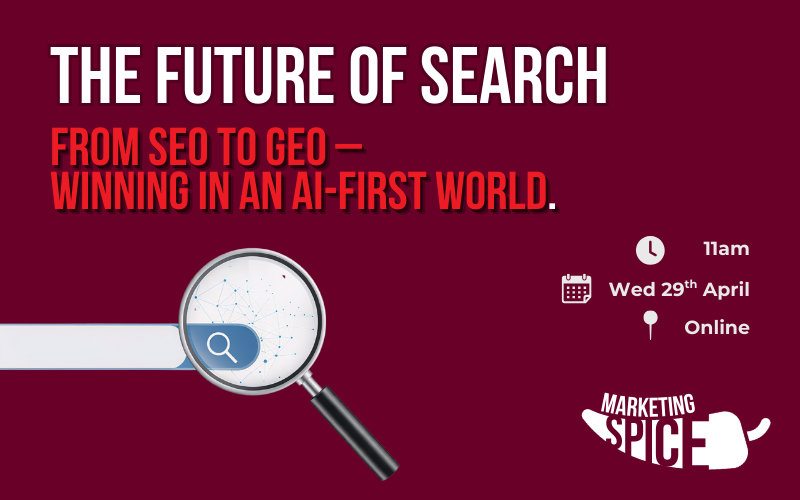
It’s also the focus of an upcoming live online panel discussion I’ll be joining on 29th April 2026, The Future of Search: From SEO to GEO – Winning in an AI-First World, hosted by the Pimento Independent Agency Network.
Myself and a group of industry specialists be looking at how search is changing in practice, what that means for visibility, and how businesses can adapt their strategies as discovery continues to shift. If you’re thinking about how this applies to your own marketing, it’s worth registering and joining the discussion.
Because while the platforms may be changing, the opportunity is the same.
The businesses that adapt early, think clearly, and focus on being genuinely useful will be the ones that stay visible — wherever their audience is searching.
SEO vs AI Search: It’s not either/or
It’s easy to frame this as a choice. Focus on Google, or focus on AI.
But as we’ve seen, that’s not how people search anymore — and it’s not how visibility works.
This isn’t about traditional SEO vs AI optimisation.
It’s about understanding how both fit together, and building a strategy that allows you to show up wherever your audience is looking for answers.
The businesses that get ahead now won’t be the ones chasing every new platform or tactic.
They’ll be the ones that stay focused, adapt early, and invest in content that’s clear, credible, and genuinely useful.
Because while the tools may change, the principle doesn’t. If you’re the best answer, you’ll be the one that gets found.
If you’re starting to think about how your content performs across both traditional search and AI platforms, that’s exactly where we can help.
👉 Explore our approach to AI search optimisation and SEO, or get in touch to arrange a conversation.