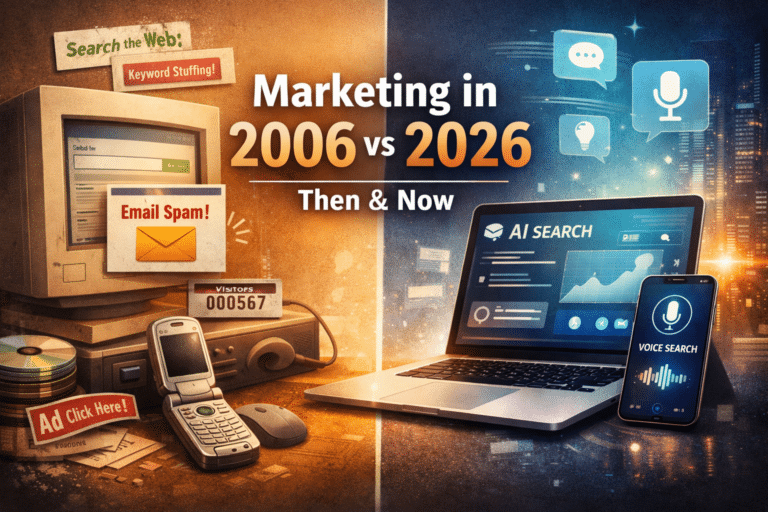
If you’re still focusing all your digital efforts on ranking in Google’s traditional search results, it’s time to zoom out.
The way people search is changing – fast. Thanks to tools like ChatGPT, Google’s AI Overviews and platforms like Perplexity and Claude, users are no longer just clicking on blue links. They’re getting instant, conversational answers powered by large language models (LLMs). And if your content isn’t being picked up by these models, you’re missing a growing share of visibility.
Enter: LLMO (Large Language Model Optimisation), GEO (Generative Engine Optimisation), and the catch-all term “AI SEO”.
These are the emerging strategies marketers are starting to talk about – but they’re not yet well understood. In fact, you might not even know what they mean yet, let alone how to act on them.
In this guide, we’ll break down what these terms actually mean, how AI search differs from traditional SEO and how to rank in AI, and what you need to do now to stay visible in this new search landscape.
What is an LLM and how does it affect search?
LLM stands for Large Language Model – a type of artificial intelligence trained on vast amounts of text to generate human-like responses. Tools like ChatGPT, Claude, Gemini and Perplexity are all powered by LLMs.
Unlike traditional search engines which return a list of links, LLMs generate direct answers.
For example, instead of typing medical symptoms into Google and scrolling through pages, a user might ask ChatGPT, “What’s the difference between a private GP and an NHS GP?” – and receive a detailed, conversational response instantly.
This shift is already changing how people search. Many now start with an LLM, using it to narrow options or understand a topic, and only then move to Google to verify or take action. In some cases, they skip Google altogether.
This means traditional keyword-based SEO is no longer enough. To stay visible, businesses need to optimise for answer engines – crafting content that LLMs can pull into their responses confidently and accurately.

LLMO, GEO & AI Optimisation: What do these terms mean?
As AI reshapes the way people search, a new wave of terminology has emerged – and it’s evolving fast. Let’s explore the most common terms – and what they actually mean.
LLMO (Large Language Model Optimisation)
This refers to the practice of optimising your content so it appears in AI-generated responses from tools like ChatGPT or Claude.
Unlike traditional SEO, LLMO focuses less on ranking web pages and more on making sure your content is trustworthy, comprehensive, and structured in a way that LLMs can confidently pull into their answers.
GEO (Generative Engine Optimisation)
A slightly broader term, GEO is about optimising for any generative AI engine – not just large language models, but platforms like Google’s AI Overviews, Microsoft Copilot, Perplexity, and others. It covers both LLMO and AI search engine behaviour.
According to SEO.ai, GEO means “optimising content to be surfaced and featured by generative AI tools during the discovery process.”
Meanwhile, Ahrefs argues that “GEO is just SEO” – their stance being that the fundamentals of good content still apply. You need quality, relevance and authority, regardless of where the content appears. Which makes a lot of sense.
AI Optimisation / AI SEO / AEO
A looser, catch-all term that’s still taking shape. You’ll often hear “AI SEO” and increasingly “AEO” used interchangeably with LLMO or GEO – but it lacks formal definition and is best seen as an umbrella for all AI-related content visibility strategies.
Here’s how all these emerging digital marketing terms stack up:
| Term | Focus Area | Channel Examples | Purpose |
| LLMO | Large Language Models | ChatGPT, Claude, Gemini | Appear in AI-generated responses |
| GEO | Generative AI engines (broader) | Google AI Overviews, Perplexity, Copilot | Be featured in AI-assisted search results |
| AI Optimisation | General visibility in AI environments | All of the above | Catch-all term for evolving strategies |
| AEO | Answer Engine Optimisation | Search engines + AI tools | Be the trusted answer when people search |
| Traditional SEO | Keyword + link-based search | Google, Bing, Yahoo | Rank web pages in the SERPs |
As you can see, these are overlapping strategies rather than competing ones – and understanding the distinctions helps you decide where to focus your efforts next.
How to optimise for LLMs
Getting found in AI-generated answers is less about understanding algorithms and more about earning trust – from users and from machines.
Here’s how to optimise your content for Large Language Models (LLMs) like ChatGPT, Gemini and Claude.
🎯 Start With Clear, Concise Answers
LLMs scan vast amounts of content to find reliable, well-structured information. That means clarity beats complexity.
- Use plain English – no jargon or filler
- Answer one key question per section or page
- Include summaries or “TL;DRs” for quick scanning (explanation below)
💡 Tip: LLMs tend to quote directly from well-formatted answers. A simple paragraph that clearly responds to a specific question (e.g. “How long does X take?”) increases your chances of inclusion.
📝 TL;DR explained:
TL;DR stands for “Too Long; Didn’t Read”. It’s a short summary placed at the top of a page or section that gives readers a quick overview of the key points. Think of it as a preview for people who are skimming – or for AI tools that prefer concise answers.
🔐 Trust Is Non-Negotiable: E-E-A-T Still Rules
LLMs prioritise content that demonstrates Experience, Expertise, Authoritativeness and Trust (E-E-A-T).
- Include author bios and credentials
- Back up facts with reputable sources (think NHS, gov.uk, academic studies
- Highlight reviews, case studies and accreditations
This applies doubly in YMYL (Your Money or Your Life) sectors like healthcare and finance.
📄 Structure Your Content for AI
AI tools love content that’s easy to parse. That means:
- Use headings, bullet points, and short paragraphs
- Add FAQ sections with clear questions and answers
- Use Schema Markup to tell search engines exactly what your content is about
- Target featured snippets and People Also Ask boxes – both feed AI Overviews
📄 Build Topical Authority
LLMs are trained to spot trusted voices in a field. One strong article is not enough – you need clusters of content that reinforce each other.
- Cover your niche in depth: the more angles you explore, the more helpful you come across
- Use internal linking to guide LLMs through your content ecosystem
This approach also helps AI crawlers – tools that scan the web to train AI models – understand how your content connects, and reinforces your authority on specific topics.

AI Search is not the death of SEO (Yet)
With all the buzz around AI-generated answers and AI as the future of search, it’s tempting to think SEO is on the way out. But traditional search isn’t dead – it’s just evolving.
Google’s classic ten blue links still matter, especially for high-intent searches. And most LLMs – from ChatGPT to Gemini – are trained on the open web. That means your website content still fuels AI responses, whether users see your link directly or not.
GEO (Generative Engine Optimisation) is not a replacement for SEO – it’s a new lens. Think of it as an expansion of your strategy, not a swap.
💡 What this means in practice:
SEO fundamentals – like site speed, meta data, backlinks and structured content – still apply.
But content must work harder: it needs to be clearer, more useful, and rooted in trust.
If you want to future-proof your rankings, the focus should be simple: be the answer, in both traditional results and AI-generated ones.
Final Thoughts: It’s time to think beyond rankings
The rise of AI search is changing what visibility really means. It’s no longer just about ranking #1 on Google – it’s about being trusted, cited and chosen by the platforms your audience turns to for answers.
Whether you call it LLMO, GEO, AI SEO or AEO, the goal is the same: create high-quality, helpful content that builds authority and delivers clarity.
📣 Don’t get lost in the jargon. Focus on what your audience needs, and how you can answer their questions better than anyone else.
If you’re ready to future-proof your SEO and grow your visibility across both traditional and AI-driven search, work with a London SEO agency that understands how search is evolving. Figment is here to help. Talk to us today to discover how we can make sure YOU are the answer to what your audience is searching for.